Advice
How many times a week should you wash your hair, depending on your hair type?
Do you have oily, dry, or colored hair? Adjust how often you wash your hair based on your hair type and keep your scalp healthy and balanced.

What is the recommended frequency for washing your hair based on your hair type?
The question of how many times a week to wash your hair comes up again and again—and for good reason. Between overwashing and insufficient hygiene, finding the right balance requires taking into account your hair type, your lifestyle, and the quality of the products you use. Here’s what you need to remember:
- ✅ Oily hair: Wash no more than 2 to 4 times a week using a mild shampoo to regulate sebum production without causing a rebound effect.
- ✅ Dry, curly, or frizzy hair: Washing it 1 to 2 times is enough. These delicate hair types need more nourishing care than frequent washing.
- ✅ Normal or finehair: 2 to 3 washes per week, depending on physical activity, the environment, and scalp sensitivity.
- ✅ Colored or chemically treated hair: Wash no more than twice a week with a sulfate-free shampoo to preserve the color and hair fiber.
The key to healthy hair lies not in frequency, but in the consistency of a proper, gentle, and elegant routine.

Why does how often you wash your hair depend on your hair type?
There is no one-size-fits-all answer when it comes to how often to wash your hair. What works for fine, oily hair could be disastrous for dry curls or weakened hair. It all comes down to observation, understanding, and the artful discipline of a personalized routine.
Oily Hair: Do You Really Need to Wash It Every Day?
An oily scalp isn't a flaw. It simply indicates more intense activity in the sebaceous glands. These glands produce sebum, the natural oil designed to protect the scalp and nourish the hair shaft. However, the more aggressively you remove it, the more the scalp tries to defend itself. It's the vicious cycle of the rebound effect.
Washing your hair too often can actually increase sebum production. If your hair gets oily again the next day, your routine may be too harsh.
To space out washes:
- Choose a dry shampoo—in powder or spray form—depending on the texture of your roots.
- Finish each wash with a cold-water rinse: this helps close the cuticles and slow down the re-oiling process.
- Brush your hair every night with a natural-bristle brush to distribute the natural oils along the length of your hair.
Dry, curly, or frizzy hair: Avoid washing it too often
These hair types are more prone to damage from washing. Their high porosity makes the hair shaft more vulnerable, while sebum—which is often trapped at the root—does not distribute naturally throughout the hair.
In these cases:
- Aim for 1 to 2 washes per week.
- Opt for nourishing treatments between washes: plant-based butters, moisturizing masks or conditioners, and light oils applied before shampooing.
Her hair needs time to regain its balance. A client with curly hair told me that, after spacing out her washes to once every ten days, her curls had softened and taken on a new shape without any effort.
Normal hair: Adopt a balanced washing routine
Hair classified as "normal" requires a regular but moderate routine. Washing it every two or three days is usually enough.
This rhythm can be:
- Wash your hair less frequently in the winter, when the scalp produces less sebum.
- Wear it shorter in the summer or when engaging in frequent physical activity.
The important thing is to stay alert: any sensation of an uncomfortable scalp or dull roots should be taken into account, without letting it become a reflex to wash your hair.
Colored or damaged hair: Space out treatments to protect the hair shaft
Every time you wash your hair, there is some loss of pigment, no matter how slight. Dyed hair is, by nature, more porous and more sensitive to surfactants.
Therefore, it is recommended that:
- Limit washing to a maximum of twice a week.
- Use a sulfate-free shampoo enriched with protective ingredients.
- Choose gentle, even creamy textures that are gentle on the hair shaft.

What factors influence the ideal frequency of washing?
Your lifestyle matters (and more than you might think)
It would be simplistic to think that only your hair type determines how often you should wash it. Your lifestyle habits are just as important:
- Exercise, especially intense physical activity, causes the scalp to sweat.
- Urban environments expose hair to microparticles and dust.
- A diet high in fats or sugars can increase sebum production.
But be careful: "dirty" hair isn't necessarily "damaged" hair. You have to distinguish between how clean your hair feels and its actual health.
There is no one-size-fits-all answer for the ideal frequency of washing
There's no such thing as a "magic" frequency. There's just your own.
Several factors can affect your needs:
- The climate (humidity, heat, dry cold)
- Styling products used (hairsprays, sprays, oils)
- Hair styling tools (heated brushes, flat irons, diffusers)
Signs to look for:
- Irritated scalp, itching, or redness
- Excess sebum, oily roots, dull appearance
- Itching, oily or dry dandruff
Learning to recognize these signs is the first step toward adjusting your laundry frequency in a fair and considerate way.
Why can washing clothes too often do more harm than good?
Washing your hair every day—unless medically advised or as part of extreme athletic activity— seriously disrupts the balance of your scalp.
This entails:
- Increased hair loss (a stressed scalp weakens the hair follicles)
- Brittle hair, due to the lack of its protective hydrolipidic film
- A loss of visual density, as the hair becomes limp and lacks body
I've noticed this in several clients who, due to excessive concern for hygiene, had weakened their hair to the point of breakage.
The key? A gentle, natural hair care routinethat’s gentle on your scalp and takes into account the hair’s natural regeneration process.

Tips for Spacing Out Washing Sessions and Maintaining Healthy Hair
In the world of hair care, anything that allows you to space out washes wisely is valuable. It’s not a matter of laziness or a passing trend—it’s a hair care strategy.
By spacing out washes, you give your scalp time to restore its natural balance, while preserving the integrity of the hair shaft. But to make this transition smoothly, you need to know the key steps.
Choose the right shampoo formula for your hair type
It all starts with choosing the right product. Shampoo isn't just a cleanser; it's a basic treatment that lays the foundation for a healthy routine. Choose a formula:
- sulfate-free, to preserve the hydrolipidic film
- pH-neutral, to be gentle on the scalp
- rich in botanical ingredients to address the specific needs of the hair (purifying clay, soothing hydrosols, balancing essential oils)
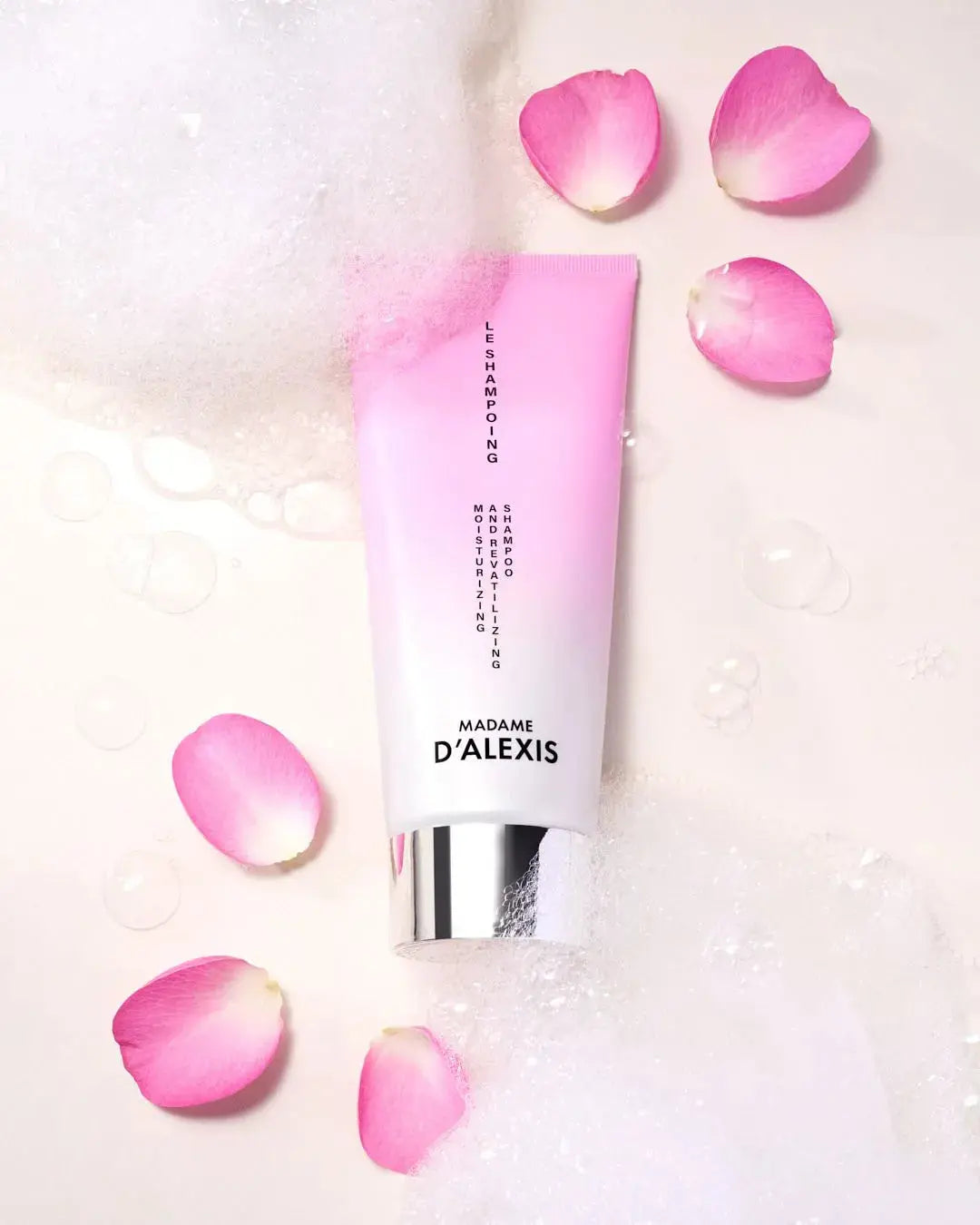
Personally, I recommend our Madame d’Alexis shampoo, which is sensorial, gentle, and highly effective. It cleanses thoroughly while respecting the natural texture of even the most delicate hair.
Keep in mind: A well-formulated shampoo not only cleans without stripping the hair but also helps extend the time between washes.
Incorporate a dry shampoo to reduce the frequency of washing
Dry shampoo is your discreet ally on days when you can't wash your hair. It's not meant to replace washing your hair, but rather to buy you some time between washes while keeping your roots looking fresh.
- Absorbs excess oil, dust, and surface impurities
- Restores volume, especially to fine or limp hair caused by chemical treatments
- Extend the elegance of a hairstyle or an elaborate hairstyle
Some golden rules:
- Apply it from a distance (about 20 cm), only to the roots
- Let it sit for a few minutes before brushing
- Choose a formula suited to your skin tone to avoid a powdery finish
Round out your routine with key moves
Spacing out your washes doesn't mean neglecting your hair. On the contrary, it means paying closer attention to the signals your scalp is sending you.
Here are some habits you should adopt:
- Brush your hair every night with a natural-bristle brush: this helps distribute sebum, gently cleanses, and stimulates microcirculation.
- Rinse your hair with cold or lukewarm water after exercising or spending a day in an urban environment, without using shampoo
- Apply a purifying or moisturizing hair mask once a week, depending on your scalp type
These steps, when repeated regularly, allow you to gradually space out your washes without compromising the appearance or cleanliness of your hair.
How many times a week should you wash your hair, according to the experts?
The answer always depends on your hair type, its condition, and your lifestyle. Here is a clear summary of the recommendations:
| Hair Type | Number of washes per week |
|---|---|
| Oily Hair | 2 to 4 washes |
| Dry, curly, or frizzy hair | 1 to 2 washes |
| Normal Hair | 2 to 3 washes |
| Colored or brittle hair | 1 to 2 washes, at most |
| Fine Hair | Every 2 days, as needed |
| Children's Hair | 1 to 2 washes, with proper care |
| After the sports activity | Mild rinse or light wash |
This chart is not an absolute rule, but rather a starting point for reflection. Observation remains the best guide: a calm scalp, shiny hair, and a pleasant texture are the best indicators of a properly adjusted frequency.