


Understanding why your hair is shedding with natural shampoo
- Discoloration is a normal reaction: the fiber is freed from silicones and regains its natural texture, which is more porous and less smooth.
- The scalp gradually regains its balance: sebum fluctuates, adjusts, and then stabilizes without harsh surfactants.
- The fiber becomes hydrophilic again, absorbs water and active ingredients better, which explains the swelling, temporary dryness, or frizz.
- Clarification is a one-time process that should not be confused with racking: it removes residues but does not replace the natural capillary transition.
- A few expert tips: regular moisturizing, ceramides, cold rinsing, and moderate heat help stabilize the fiber and speed up adaptation.
Madame d'Alexis natural sulfate-free, silicone-free shampoo
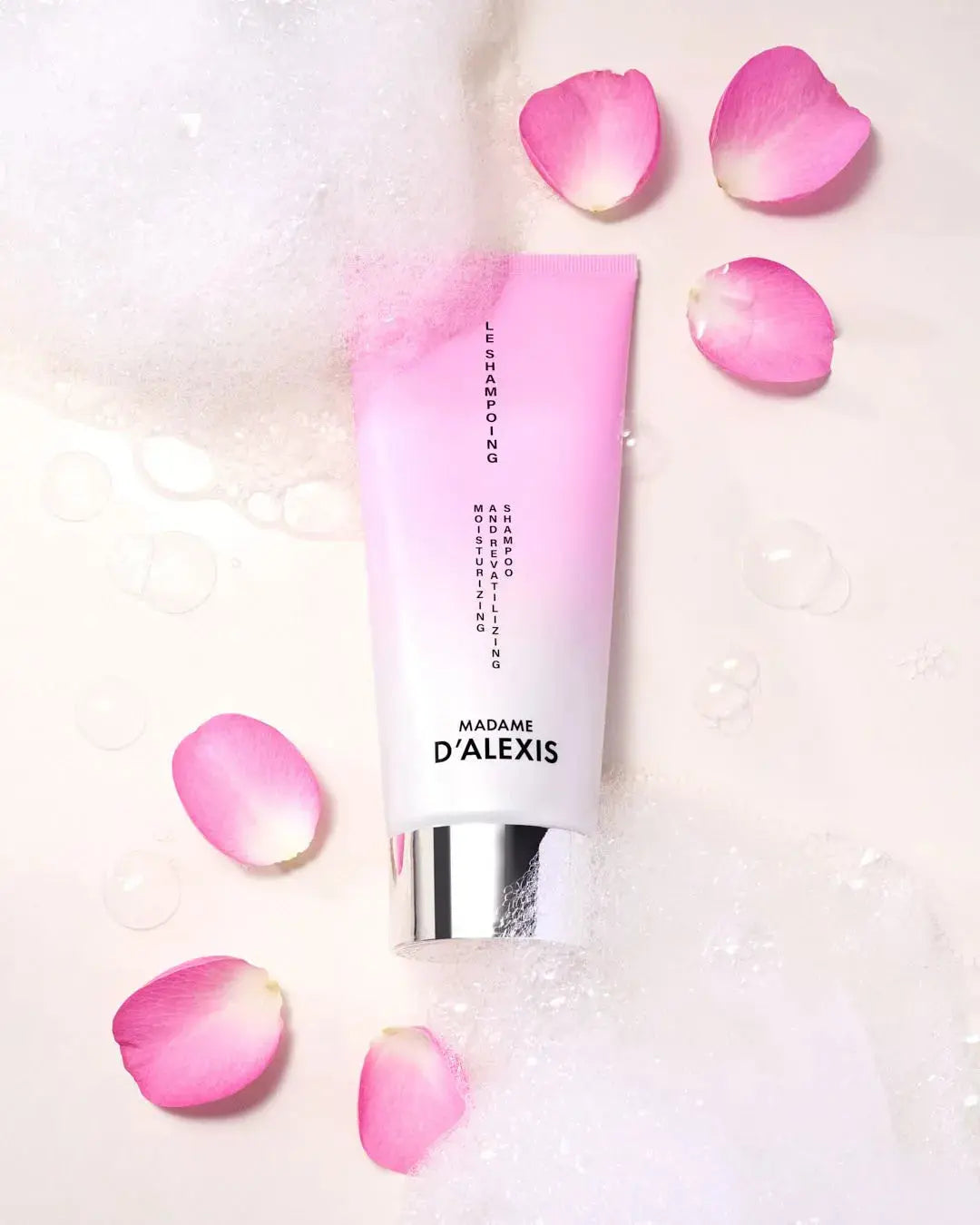
Why does hair "bleed" when switching to natural shampoo?
Hair purging: the normal reaction after stopping silicones
When a person stops using conventional shampoos that are rich in silicones, film-forming polymers, and harsh surfactants, their hair often goes through a phase called hair detox.
This is a perfectly normal reaction. Silicones deposit a smoothing film that gives an impression of softness and shine, but masks the actual condition of the fiber.
Their disappearance exposes porous areas, raised scales, and irregularities that were previously covered by the occlusive film.
What really happens in the fiber: loss of the occlusive film and "bare" texture
Capillary discharge begins when the fiber loses its artificial coating. Without this film, the hair becomes hydrophilic again. It absorbs more water, changes volume, and reacts more visibly to ambient humidity.
This phase may come as a surprise because it reveals the biological reality of the hair: its porosity, its actual moisture content, and the quality of its cuticles.
This is a transitional stage, a sign that the fiber can finally interact properly with the active ingredients in natural skincare products.
Dry, dull, or frizzy hair: typical signs of color fading
Hair may appear drier, duller, or even puffy. This is a logical consequence of returning to a natural texture. I often find that these signs cause unnecessary concern: they last only a few shampoos and form the basis for lasting repair.
The hair is no longer coated, and actually begins to absorb the moisture, ceramides, or hydrosols present in natural formulas.
How to use natural shampoo?
Disgorging vs. clarification: two concepts that are often confused
What is capillary discharge? (physiological reaction)
Degorgement is a spontaneous biological phenomenon. It marks the adaptation of the hair and scalp to the cessation of occlusive substances. Nothing is "deliberately cleaned": it is the fiber that rebalances itself naturally.
What is hair clarification? (deliberate action)
Clarification, on the other hand, is a one-time treatment. It involves removing stubborn residues (heavy silicones, minerals, pollution) using a purifying shampoo or a gentle method. It is an intentional action, not a physiological reaction.
Disgorging or clarification? How to tell the difference between the two
- Fading: natural reaction, multiple shampoos, "bare" texture, drier or puffier hair.
- Clarification: single cleaning, immediate results, lighter and "stripped" fiber feel.
- Key difference: clarifying reveals the true condition of the hair; clarifying prepares a clean base.

Why does your hair react differently to natural shampoo?
The return effect to actual porosity
Switching to a natural shampoo upsets the balance of the hair because it gradually removes the occlusive films left behind by silicones and polymers. These substances artificially smooth the fiber and even out its surface.
As soon as we stop using them, hair regains its true porosity, the way it was before being covered up. This is a key moment: the fiber is no longer disguised and shows itself as it really is, with its strengths and weaknesses.
This "reappearance" of porosity can result in some unexpected behaviors: slight swelling, a more pronounced reaction to moisture, or an immediate loss of shine. This is not unusual.
This is not a sign of further damage, but an indication that the cuticles are functioning naturally again. It is precisely this step that allows the active ingredients in clean skincare products to penetrate properly.
The scalp regains its balance without harsh surfactants
A natural shampoo does not use the same cleansing agents as a conventional formula. Whereas a sulfate surfactant strips the hair, a mild surfactant cleanses without disrupting the hydrolipidic film. The scalp must then relearn how to produce sebum independently, without being overstimulated or, conversely, overly dried out.
During this period, the following can be observed:
- a variation in sebum,
- roots that are sometimes fatter in the first few days,
- or, conversely, a temporary feeling of dryness.
It is a strictly physiological adaptation. Once balance is restored, the scalp becomes more stable and significantly less reactive.
Hydration that finally penetrates (restored hydrophilicity)
When the fiber is no longer covered with a silicone film, it becomes hydrophilic again. It absorbs water and care products, which can cause a change in texture.
A fiber that "drinks" better can swell, take longer to dry, or have more bounce. Again, this is a positive sign: the hair is finally receiving real hydration, not just superficial moisture.
Should you clarify your hair before or during the flushing phase?
When clarification is necessary (and when it is not)
Clarification is useful when hair saturated with residue struggles to free itself from old layers of product. This is particularly true when heavy silicones have been used for months.
In this specific case, a single clarification at the beginning of the transition can facilitate the disgorging phase. However, when the fiber is not heavily coated, this step is not essential.
How to clarify without damaging the fiber (gentle methods)
Clarifying is not the same as stripping. The goal is not to weaken the fiber, but to remove residues that prevent natural active ingredients from working. To do this, we recommend:
- a gentle clarifying shampoo formulated without harsh sulfates,
- or a homemade clarifier made from clay or diluted vinegar.
The key is to always follow up with a moisturizer to close the cuticles and maintain suppleness.
Why over-clarifying can worsen disgorging
Excessive clarification increases the opening of the cuticle and accentuates the feeling of dryness. It can cause more swollen fibers and an unstable scalp.
The most common mistake is to repeat the clarifying process in the hope of "going faster." In reality, this prolongs the stripping phase and can weaken the hair.
The rule is simple: once is enough, except in exceptional cases.

How long does it take for hair to clear up with natural shampoo?
Average duration depending on the type of fiber
The duration of the cleansing process depends on the amount of residue accumulated and the porosity of the fiber. In general, two to four shampoos are sufficient for the hair to adapt and stabilize its behavior.
Thick, porous hair often progresses faster, while very fine fibers may require a little more time (up to 8 shampoos in some cases).
Extended duration: for hair with high silicone content
When silicones have been used regularly for months, the film may take longer to disappear. In these cases, the transition may take six to eight shampoos, which is nothing to worry about. The gradual decline of the artificial varnish is a sign of normalization, not deterioration.
Signs that your natural transition is successful
A transition is considered stabilized when:
- the shine becomes softer but more even,
- the fiber responds better to care,
- frizz is reduced,
- the scalp produces stable sebum,
- The texture remains consistent from wash to wash.
At this stage, the hair is no longer undergoing transition: it is functioning in a healthy, balanced, and sustainable manner.
How to deal with hair that sheds?
Essential steps to reduce dryness and frizz
When hair is washed, it reacts more "vibrantly" than usual. The cuticles open up, the fiber absorbs more water, and the texture sometimes becomes unpredictable.
To get through this phase, a few simple steps are all it takes, provided they are done regularly.
Hairdressers have observed that hair fibers cope much better with the transition when the following are prioritized:
- Gently detangle wet hair, ideally with a soft-bristled brush.
- rinse with warm water followed by a blast of cold water to tighten the cuticles,
- dry without rubbing, by dabbing with a microfiber towel,
- Moderate heat if you are using a hair dryer.
These actions have one thing in common: they limit mechanical damage. The fiber, which is temporarily more sensitive, requires caution rather than performance.
Active ingredients that stabilize the fiber (hydrolats, ceramides, cationic HA)
During the degorgement phase, certain active ingredients play a decisive role. They do not replace the occlusive film left by silicones; they restore natural functioning.
Hydrosols are the first pillar. Their composition, rich in light aromatic compounds, promotes hydration and soothes the scalp. They gradually rebalance sebum and improve suppleness without weighing hair down.
Ceramides, on the other hand, strengthen the bonds between the scales. They fill in porous areas, stabilize the fiber, and help it retain moisture.
Cationic hyaluronic acid works differently. Attracted to negatively charged areas of the hair, it attaches itself where the fiber needs it most. It provides targeted, long-lasting hydration, which limits the feeling of dryness that is characteristic of color fading.
Mistakes to avoid during this disgorging phase
Certain habits can prolong or aggravate bleeding:
- use clarifying shampoos more often,
- using products that are too harsh,
- rub the fiber during drying,
- repeated blow-drying or straightening without heat protection.
All these mistakes disrupt the cuticles just as they are trying to reorganize themselves. The natural transition requires a form of restraint, almost a discipline.

Recommended hair care routine for a successful transition to natural products
Natural shampoo: frequency and massage techniques
It is best to space out washes slightly at first. Two to three shampoos per week are sufficient. Massage the scalp slowly with your fingertips to activate microcirculation without causing irritation.
This technique promotes sebum regulation and improves the distribution of hydrolats in the fiber.
Moisturizing masks and repairing treatments: which ones should you choose?
During the first few weeks, it is wise to increase hydration. Formulas containing hydrosols, light oils, plant ceramides, or humectant acids are particularly suitable.
They restore suppleness without creating an artificial "varnish." Masks rich in very thick oils, on the other hand, are less suitable at this time of year, as they may saturate the hair fiber.
How to seal in moisture and smooth the cuticle without silicones
To smooth the scales without using silicones, we combine three elements:
- regular hydration,
- lightweight thermal protection,
- and a serum rich in ceramides.
This trio forms a flexible barrier that retains water in the fiber and limits frizz. Hair becomes more manageable without losing its natural movement. This allows for a comfortable transition while preparing the fiber for long-lasting health.
Natural routine shampoo, mask, and serum Madame d'Alexis
FAQ: all questions about hair shedding
Is it normal for my hair to look bad after the first time I use natural shampoo?
Yes, and this is actually the most common reaction when people stop using products containing silicones. These silicones form a smoothing film that masks dryness, porosity, or irregularities in the hair fiber.
When this film disappears, the hair returns to its biological reality: a drier texture, less shine, and sometimes more volume. This is not a regression, but the logical consequence of hair that is no longer "made up."
Once this stage is over, the fiber regains its suppleness and learns to interact with natural care products again.
Can the hair shedding phase be avoided completely?
Not quite. You can reduce its intensity, but you can't erase its logic. Degorging corresponds to the readaptation of the hair fiber and scalp to an environment free of occlusive agents and aggressive surfactants.
As long as silicones coat the hair shaft, the fiber functions as if it were on life support: neither moisture nor active ingredients can truly take effect. Once they are removed, the fiber must relearn how to function on its own.
However, you can soften the phase by moisturizing more, avoiding repeated blow-drying, spacing out washes slightly, or using formulas that are very rich in moisturizing agents. This limits discomfort, but the transition remains inevitable.
Does bleaching damage hair?
No. Degorging does not cause any new damage; it reveals damage that was previously invisible. When they lose their varnish, the cuticles appear more open, the surface rougher, and the fiber less "smooth."
This appearance may give the impression that the hair is deteriorating, when in fact it is simply revealing its true condition. This is actually the stage that allows for true repair. Once rid of its film, the hair can finally absorb water, ceramides, humectants, and light oils.
The reconstruction process only becomes effective once the fiber is accessible.
Why does my hair become frizzy after using natural shampoo?
Swelling is a sign of rehydration. A fiber coated with silicone is hydrophobic: it repels water. When you switch to natural fibers, the fiber becomes hydrophilic again. It absorbs water quickly, swells slightly, and changes its volume.
This phenomenon is often more visible on curly or wavy hair, as their cuticles are never perfectly aligned.
Swelling is therefore not a defect. It is the direct result of hair returning to its normal water content. This ability to "drink" moisture prepares the hair for the next phase: stabilization.
Is color fading more pronounced on colored or curly hair?
Yes, and for different reasons. Colored hair often has high porosity because coloring opens the cuticles to allow the pigments to penetrate.
When the silicone film disappears, this porosity reappears immediately, making the hair more sensitive: increased volume, uneven shine, drier feel. Curly hair, on the other hand, has a naturally irregular structure.
Sebum circulates less easily and the cuticles do not lie perfectly flat. Without silicones to temporarily smooth them, the curl fully expresses its bounce and texture. The frizz therefore appears more pronounced, but it is simply the natural expression of the fiber.
In both cases, once the transition is complete, these hair types often benefit most from a natural look: more defined curls, deeper colors, and more supple fibers.
My hair feels sticky after using natural shampoo. Is this normal?
Yes. This sensation often occurs when silicone residues mix with natural sebum. Mild surfactants do not immediately strip away old layers of product; they remove them gradually. During this period, the hair fiber may feel sticky or heavy. Once the scalp is rebalanced, the sensation disappears on its own.
Why does my hair become dull at the beginning of the transition?
The "mirror-like" shine of conventional hair care products comes from a silicone film. When this film wears off, the artificial shine disappears with it. The hair regains a more diffuse, less spectacular but more authentic shine. When moisture returns naturally, the shine reappears, softer and longer lasting.
Why does my hair get greasy faster with natural shampoo?
The scalp must readjust to functioning without harsh surfactants. Conventional shampoos overstimulate the sebaceous glands; when you stop using them, sebum levels fluctuate for a few washes. This is a normal adjustment and not a sign that natural shampoo is "greasy ."
Why is my hair still coarse even after using a hair mask?
The fiber, freshly stripped of its cosmetic film, absorbs water and then releases it very quickly. This alternation causes a rough feel, even if the mask has worked. With repeated moisturizing treatments, the cuticle stabilizes and softness returns.
Why are my roots clean but my lengths seem dry?
The lengths have accumulated more heat, friction, and products than the roots. When they are stripped of their protective film, they reveal their true porosity. This contrast between roots and ends is typical during the transition.
My scalp has been itchy since I switched to natural products. Should I be concerned?
Generally speaking, no. This itching indicates that the hydrolipidic film is rebalancing itself or that old residues are gradually disappearing. Soothing hydrosols such as rose or chamomile are often enough to calm the area within a few days.
Can I have dandruff during the purging process?
Yes. The scalp may flake more as it restores its balance. This flaking is temporary. A mild shampoo and moisturizing treatments will quickly stabilize the situation.
Can natural shampoo reveal irritation that is already present?
Yes. Silicones can mask signs of skin imbalance. Once removed, the scalp sometimes reveals what was already latent. This allows you to tailor your routine in a more targeted way.
How many shampoos does it take to completely get rid of dandruff?
Most people find that their hair stabilizes after three to six washes. Highly siliconed fibers may take longer, sometimes up to eight or ten shampoos. Beyond that, it is useful to check the washing technique or the products used.
Why does disgorging take longer in some people?
The duration depends on the amount of residue accumulated, the porosity of the fiber, the hair type, and the health of the scalp. Fine hair that is highly exposed to heat often takes longer to respond.
Can there be several stages of disgorging?
Yes. This can happen after excessive clarification or when switching to a natural shampoo. The hair fiber reacts, then stabilizes.
Does the pH of shampoo play a role in unclogging drains?
Yes. A high pH opens the cuticles more. Well-formulated natural shampoos maintain a pH close to that of the scalp to avoid increasing roughness.
Why do silicones mask porosity so much?
Because they physically fill in irregularities. Their structure temporarily smooths the surface, giving a deceptive smoothness. Once removed, the fiber regains its actual surface.
Do mild surfactants prolong the disgorging process?
No. They make the transition more comfortable. An aggressive surfactant would speed up the effect but at the expense of the scalp.
Does the scalp microbiome change during this phase?
Yes. It rebalances itself as soon as the irritants disappear. This rebalancing may cause temporary fluctuations, but it then strengthens the stability of the scalp.
Should I change my routine during purging?
Not necessarily. It's better to adapt it: more hydration, less heat, gentle and consistent products. Consistency is more useful than adding new products.
What treatments should be avoided during this phase?
Repeated clarifications, overly harsh shampoos, mineral oils, and silicones. These further disrupt already unstable cuticles.
Should you brush your hair more or less often during the transition?
Moderately. Brushing too often weakens porous hair, but not brushing at all encourages tangles. The key is to find a balance with gentle detangling suited to your hair texture.
Does going natural really make hair more beautiful after the transition?
Yes, but it's a different kind of beauty. Less artificial, more consistent. Hair becomes more supple, stronger, and more even over time.
How can I tell if my hair has accepted the natural shampoo?
When the texture becomes stable from one wash to the next, sebum is regulated, the fiber responds better to treatments, and frizz is reduced. This is a sign that the fiber has regained its natural function.

