


Natural shampoo: when washing becomes hair care
For a long time, shampoo was considered a simple cleansing product. Its purpose was limited to removing sebum, pollution, and residue, often at the cost of repeated damage to the scalp. Today, this approach is showing its limitations. Dull hair, sensitive scalp, chronic imbalances: washing is no longer enough.
Natural shampoo follows a different logic. It does not seek to strip away everything to make hair "clean," but rather to cleanse gently, respecting the ecosystem of the scalp and the structure of the hair fiber.

This development is not a passing trend. It reflects a growing awareness that hair, like skin, needs appropriate, regular, and gentle care.
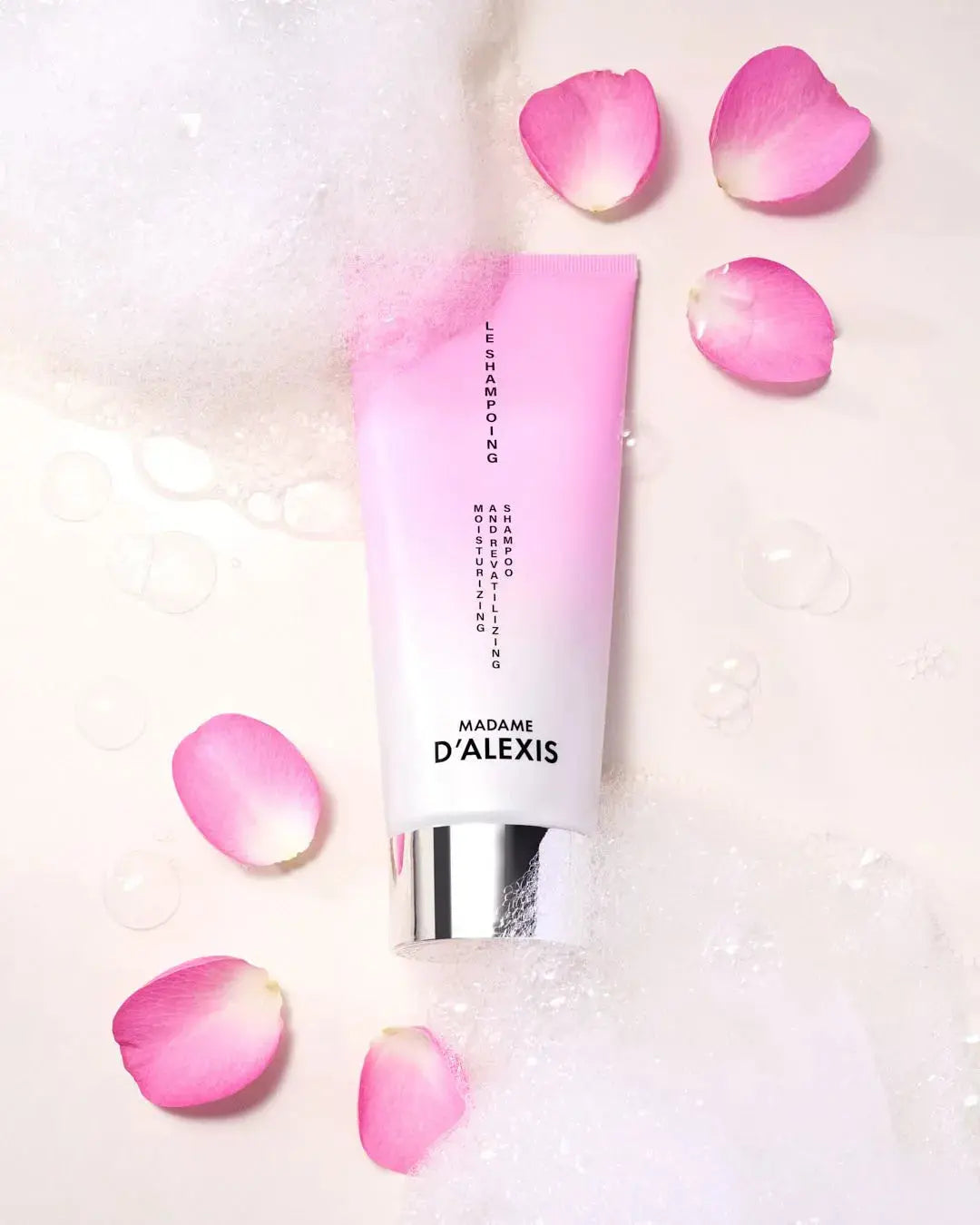
At Madame d'Alexis, this conviction led to a radical choice. A single natural shampoo, formulated as a genuine treatment. A shampoo designed to act on both the scalp and the hair fiber, without compromising on effectiveness, sensoriality, and respect for life.
What is a natural shampoo today?
A modern natural shampoo is not defined solely by the origin of its ingredients. Above all, it is based on a consistent formulation. The aim is not to add a bunch of plant-based active ingredients, but to build a respectful base that can clean without causing disruption.
Two approaches still coexist on the market.
The first remains superficial. It simply incorporates a few botanical extracts into classic formulas, which are often rich in harsh cleansing agents. The result is immediate but misleading: the scalp is weakened and the hair fiber is damaged in the long term.
The second, more demanding approach is based on clear fundamentals:
- mild surfactants, which clean without stripping,
- an aqueous base suitable for the scalp,
- functional assets chosen for their real usefulness.
An effective natural shampoo respects the hydrolipidic film, preserves the skin's balance, and prepares the hair for subsequent treatments. It does not correct imbalances by force. It supports their rebalancing.
The real difference, therefore, is not in the label, but in the very structure of the formula.
Why the base of a natural shampoo makes all the difference: water or hydrosols
In most shampoos, the base is water. This water is known as "inert," meaning it has no particular effect on the skin or hair. Its main purpose is to act as a carrier for the other ingredients.
Hydrosols offer a radically different alternative. Produced through gentle distillation of plants and flowers, they naturally contain water-soluble active molecules. Their pH, which is close to that of the scalp, promotes immediate affinity.
Used as a base for formulations, hydrosols enable:
- more subtle and gradual hydration,
- better skin tolerance,
- respect for the scalp microbiome,
- a soothing effect right from the wash.
It is this choice that sets Madame d'Alexis natural shampoo apart. Formulated without added water, using only organic hydrosols, it transforms washing your hair into a genuine care ritual. The scalp is soothed and the hair fiber becomes more supple, without feeling heavy or looking artificial.
A shampoo that cleanses, yes. But above all, a shampoo that cares for your hair.

Why choose a natural shampoo for your hair?
Choosing a natural shampoo is not a militant gesture. Above all, it is a choice of consistency.
When we look at the condition of many scalps today—irritated, uncomfortable, prone to recurring imbalances—we understand that the problem does not come solely from the hair, but from the way it is washed.
A well-formulated natural shampoo does not seek to strip the hair to give an immediate feeling of cleanliness. It cleanses precisely, respecting the ecosystem of the scalp and the structure of the hair fiber.
For the scalp: soothe and regulate long-term
The scalp is skin in its own right. When it is attacked too frequently or too intensely, it defends itself. This often results in itching, tightness, or excessive sebum production.
A natural shampoo works differently:
- it cleans without altering the natural protective film,
- it limits irritation caused by repeated washing,
- it promotes gradual sebum regulation,
- It improves comfort from the very first uses.
With a consistent routine, washes can be spaced out more easily. The scalp returns to a more stable state, without any rebound effect.
For hair fiber: strengthen without weighing it down
Hair fibers are subjected to numerous daily aggressions. Heat, friction, coloring, pollution. A shampoo that is too harsh accentuates these weaknesses.
A well-designed natural shampoo allows you to:
- a more flexible, less rigid fiber,
- a gradual reduction in breakage,
- a more natural shine, without an artificial film,
- hair that is easier to style.
The difference is not always visible after just one wash. It becomes apparent with regular use. It is a long-term process, but one that is more sustainable.
For the environment: a more controlled impact
Natural shampoo is also part of a more responsible approach. The formulas favor plant-based ingredients, which are better tolerated by the environment once rinsed. But the benefits go beyond the composition.
A balanced scalp requires fewer products, less excessive washing, and fewer permanent corrections. It is a more sober, more reasoned approach that avoids overconsumption.
Can a single natural shampoo be suitable for multiple hair types?
The answer is yes, provided you understand one essential thing: it's not just the type of hair that matters, but the condition of the scalp.
The condition of the scalp before the hair type
Dry, normal, sensitive, or dull hair often has one thing in common: a scalp that has been thrown off balance by unsuitable washing products. An effective natural shampoo acts first and foremost at this level.
Depending on your needs, the same shampoo can be used for different hair types:
- Dry hair: targeted hydration helps restore suppleness and comfort without leaving hair greasy.
- Normal hair: the goal is to preserve the existing balance without creating an artificial imbalance.
- Sensitive scalp: gentle bases and soothing active ingredients promote tolerance and comfort.
- Dull hair: a less damaged cuticle reflects light better, resulting in a clearer shine.
What makes this versatility possible
A natural shampoo can be suitable for several situations when it is based on:
- a gentle cleansing base,
- a pH level that is gentle on the scalp,
- active ingredients that moisturize and protect without weighing down the skin.
The role of gestures in effectiveness
Even the best formula depends on how it is used. To get the most out of a natural shampoo:
- focus on a gentle scalp massage,
- apply the product mainly to the roots,
- let the foam rinse the lengths,
- Rinse thoroughly with lukewarm water.
It is often this combination of the right formula and controlled application that allows a single natural shampoo to meet multiple hair needs, without multiplying products or complicating your routine.
Summary table: How natural shampoo adapts to different hair needs
| Hair care needs | Main issue | Action of natural shampoo | Expected result |
|---|---|---|---|
| Dry hair | Lack of water, rigid fiber | Targeted hydration without a greasy feel | Softer hair, soft to the touch |
| Normal hair | Fragile balance | Gentle cleaning without disturbing | Healthy hair, stable over time |
| Sensitive scalp | Discomfort, tightness | Gentle and soothing cleansing base | Long-lasting comfort, fewer reactions |
| Dull hair | Irregular cuticle | Non-aggressive cleaning, smoothed fiber | Natural shine, luminous hair |
| Roots that quickly become greasy again | Scalp imbalance | Gentle cleaning, gradual regulation |
Lighter roots, less frequent washing |

Natural shampoo and oily hair: avoid the classic mistake
Oily hair is rarely a sign of insufficient cleansing. On the contrary, it is very often the result of overly aggressive cleansing. This is a classic mistake.
The faster your roots get greasy, the more you tend to use strong shampoos, sometimes on a daily basis. And the more you unintentionally stimulate sebum production.
Harsh shampoos strip the scalp. They remove not only excess sebum, but also the skin's natural protective film. The scalp then reacts like any skin that has been attacked: it defends itself. This defense takes the form of excess sebum production, often visible the day after washing. A vicious cycle sets in.
A gentle natural shampoo works in the opposite way. It does not seek to "dry out" the roots, but to gradually rebalance the functioning of the scalp. It is a slower approach, but much more sustainable.
A rebalancing shampoo is based on three essential pillars:
- A physiological pH, close to that of the scalp, which prevents excessive opening of the cuticle and disruption of the skin barrier.
- Non-stripping cleansing, provided by mild surfactants capable of removing impurities without causing a defensive reaction.
- Respect for the microbiome, that invisible but fundamental ecosystem that naturally regulates sebum production.
When these conditions are met, the scalp gradually returns to a more stable rhythm. The roots become less oily, washing can be spaced out, and the feeling of freshness lasts longer.
Madame d'Alexis natural shampoo follows this logic. It does not promise a "dry" scalp after the first use. It aims for lasting balance, without aggression or rebound effects.
The key ingredients of a truly effective natural shampoo
An effective natural shampoo is not based on a multitude of ingredients, but on specific choices. Each component must have a clear, useful, and measurable function.
Organic hydrosols
Hydrosols are floral waters produced by distilling plants. Unlike regular water, they naturally contain water-soluble active compounds.
- Rose: soothing, it contributes to scalp comfort.
- Chamomile: known for its calming properties, ideal for sensitive scalps.
- Orange blossom: rebalancing, it brings softness and tolerance.
Used as a base for formulations, hydrosols offer immediate affinity with the scalp.
Cationic hyaluronic acid
The hyaluronic acid contained in the shampoo is a recognized moisturizing active ingredient. In its cationic form, it adheres better to the hair fiber.
- It captures water and retains it within the hair shaft.
- It improves flexibility without weighing you down.
- It limits dehydration caused by repeated washing.
It is a key ingredient for balancing light roots and comfortable lengths.
Prebiotics
Prebiotics support the balance of the scalp microbiome.
- They promote stable skin flora.
- They limit the imbalances responsible for excess sebum or discomfort.
- They contribute to better tolerance in the long term.
Plant-based keratin
Plant-based keratin helps strengthen the fiber structure.
- It improves hair strength.
- It limits damage caused by mechanical stress.
- It provides a softer feel, without stiffness.
Mild surfactants of plant origin
They clean without being rough.
- Derivatives of sugar or coconut.
- Well tolerated by the scalp.
- Effective even with finer foam.
Ingredients to avoid in natural shampoo
A shampoo may claim to be natural while containing ingredients that are not suitable for regular use. Knowing how to identify them helps to avoid long-term imbalances.
-
Aggressive sulfates
They clean thoroughly, but weaken the scalp and stimulate sebum production. -
Silicones They give an immediate illusion of softness, but build up on the fiber, suffocate the hair, and dull the hair over time. -
Parabens
Although used less and less, they are still associated with tolerance issues in some people. -
Aggressive alcohols
They dry out the scalp and hair lengths, increasing discomfort and breakage.
An effective natural shampoo does not need any gimmicks. Its performance is based on balance, consistency, and regular use. It is this approach, which is more respectful and sustainable, that results in truly healthier hair, wash after wash.
How to use natural shampoo for real results
A natural shampoo works best when used correctly. This is often underestimated. Many disappointments stem not from the formula, but from the technique. Washing your hair with a natural shampoo requires a slight adjustment, but the benefits are real and long-lasting.
Using a natural shampoo with curly hair
Lukewarm water, a detail that changes everything
Water that is too hot opens the cuticles excessively and stimulates sebum production. Conversely, lukewarm water is gentle on the scalp and hair fiber. It cleanses effectively without damaging the hair. That's the basic principle.
Double washing, a key reflex
A natural shampoo cleanses gently. The first wash removes surface impurities. The second wash actually cleanses the scalp.
This double wash allows:
- greater effectiveness without overdosing the product,
- a finer, more evenly distributed foam,
- A truly clean scalp that is treated with respect.
Scalp massage
Shampoo should be applied mainly to the roots. Gently massaging with your fingertips stimulates microcirculation without irritating the scalp. It helps remove impurities and promotes a healthier scalp. There is no need to rub the lengths of your hair: the foam that runs down is sufficient.
The ideal frequency
With a natural shampoo, the goal is not to wash more, but to wash better. Two to three washes per week are sufficient in most cases. By sticking to this frequency, the scalp gradually regains its balance.
The transition phase
The first two to three weeks may be surprising. Your hair may seem oilier or more unruly. This is normal. Your scalp is readjusting after years of harsh products. This phase is temporary. It marks the beginning of a return to balance.
Use a natural shampoo for dry hair
Madame d’Alexis natural shampoo
At Madame d'Alexis, natural shampoo was not conceived as just another product. It was formulated as a cleansing treatment, capable of acting on the scalp and hair fiber with the same high standards as a facial treatment.
Its formula is based on strong choices:
- 98% natural ingredients, without compromising on effectiveness,
- no added water, replaced by bioactive hydrosols,
- French manufacturing, a guarantee of expertise and traceability,
- A skincare inspiration, where each active ingredient has a specific role.
This shampoo does not seek to mask hair problems. It works gradually and deeply. It cleanses without stripping, moisturizes without weighing hair down, and soothes without suffocating. Used regularly, it fits into a simple, clear, and effective routine.
It is a shampoo that respects the hair's natural cycle. A cleansing treatment, not just a mechanical action.
Solid shampoo or liquid shampoo: which format should you choose?
| Criterion | Liquid shampoo | Solid shampoo |
|---|---|---|
| Presentation | Most common format, ready to use | Compact shampoo bar |
| User experience | A familiar gesture, easy to incorporate into everyday life | Apply directly to wet hair |
| Dosage | Accurate and flexible | More intuitive, requires some time to get used to |
| Foam | Regular and consistent | Thinner, depends on friction |
| Practicality | Ideal for a daily bathroom routine | Perfect for travel and sports |
| Preservation | Simple, closed bottle | Excellent, especially with a soap dish |
| Environmental impact | Depends on the packaging | Less plastic, more eco-friendly format |
| Duration of use | Classic | Longer for the same use |
| Recommended hair type | Fine hair, normal hair | Long hair, frequent use |
| Primary use | Comfort, consistency, precision | Mobility, ecological approach |
FAQ Natural shampoo
Why does natural shampoo lather less?
Foam depends on the type of surfactants used. Mild surfactants foam less than aggressive agents, but clean just as well. Foam is not an indicator of effectiveness.
My hair gets greasy more quickly at first. Is this normal?
Yes. This is the transition phase. The scalp rebalances its sebum production after being stripped for a long time. This phase usually disappears within two to three weeks.
How often should you use natural shampoo?
Two to three times a week. The goal is to gradually space out washes, not to increase them.
Is it suitable for colored hair?
Yes. A gentle natural shampoo respects the hair fiber and limits the loss of shine associated with harsh washing.
Is it suitable for sensitive scalps?
Yes, when it is formulated with mild bases and soothing active ingredients. It is often even a better option for restoring comfort.
Which natural shampoo should you choose?
Choosing a natural shampoo is not about looking for a universal formula, but about identifying what really suits your hair type and scalp condition.
- Normal hair: choose a gentle, balancing natural shampoo that cleanses without disturbing the hair's natural balance.
- Dry hair: choose a moisturizing formula that can support the hair fiber without weighing it down.
- Curly hair: look for a natural shampoo that respects the shape of the hair, moisturizes, and limits breakage.
- Oily hair: choose a natural, gentle cleansing shampoo designed to regulate sebum production without stripping the hair.
My advice is simple: always choose a shampoo based on your scalp type before considering the length of your hair. That's where it all starts.
What are the benefits of organic shampoos?
An organic shampoo goes beyond a shampoo that is simply natural. It meets strict formulation and manufacturing criteria.
The main advantages are clear:
- Free from harsh sulfates, so less irritating to the scalp.
- Free from parabens, which often cause intolerance in sensitive skin.
- Free from silicones, which suffocate the fiber and create cosmetic dependency.
- Ingredients of natural origin, selected for their affinity with the skin and hair.
- A formula that respects the hair fiber and has a long-lasting effect.
An organic shampoo does not provide immediate artificial results. It gradually improves the health of your hair.
How to use natural shampoo?
Using naturalshampoo involves simple but precise steps. Natural shampoo is designed to gently cleanse without damaging the scalp or hair fibers.
The first step isto apply it to the scalp. The shampoo should not be spread directly onto the hair. Gently massaging it in helps to remove impurities while maintaining the skin's balance.
For real results:
- prioritize a regular hair care routine,
- use lukewarm water,
- Wash once or twice briefly, depending on the condition of the hair.
- Let the foam rinse through the lengths to clean the hair without damaging it.
A natural shampoo used correctly helps improve hydration, as it does not damage the hair's protective layer. It is this gentle and consistent approach that leads to healthier hair in the long term.
What ingredients should be avoided in shampoo?
To prevent shampoo from upsetting the balance of the scalp or weakening the hair fiber, certain ingredients must be identified and avoided, even when the product is marketed as natural.
To be avoided at all costs:
- formulas that do not comply with sulfate-free standards and still contain harsh cleansing agents,
- products advertised as silicone-free but replaced with other occlusive agents,
- shampoos formulated with unnecessary chemicals,
- parabens, still present in some bases,
- aggressive fatty alcohols contained in certain shampoos, responsible for dryness and breakage,
- more broadly, harmful ingredients that strip or suffocate the hair.
A good natural shampoo is based on the transparency of its formula. The fewer unnecessary ingredients it contains, the more respectful it is of the scalp and hair fiber.
How to choose a shampoo for oily hair?
For oily hair, the most common mistake is to look for a shampoo that is too strong. This stimulates sebum production.
A suitable natural shampoo should:
- offer gentle cleaning,
- respect the scalp,
- help regulate hair without drying it out.
With the right shampoo and the right frequency, the roots become less oily and balance is gradually restored.
What types of natural shampoos are there?
There are several types of natural shampoos, each designed for different uses:
- Liquid shampoo: the most common type, easy to use on a daily basis.
- Solid shampoo: convenient for travel, but sometimes more alkaline.
- Organic shampoo: certified, with strict criteria.
- Sulfate-free shampoo: gentler on the scalp.
- Neutral shampoo: minimalist, often well tolerated.
The choice depends on your habits, your scalp, and your sensory expectations.
How can you revitalize damaged hair?
Damaged hair needs regular care, not harsh solutions.
To revitalize them:
- use a gentle repairing shampoo,
- combine it with a nourishing hair care product,
- avoid washing too frequently,
- Choose a routine that restores shine and suppleness.
A well-formulated natural shampoo plays an important role in this repair process, respecting the hair fiber instead of weakening it further.

