Conseils
Heat protection for hair: how to protect the hair fiber?
Do you use a hairdryer or straightener, and find that your ends dry out quickly? Discover how to effectively protect your hair from heat with a heat-protective treatment inspired by skincare.

Effectively protecting your hair from heat: the essentials to remember
- Heat weakens the hair fiber by causing dehydration, breakage, and opening the cuticles.
- A heat protectant treatment or a heat protectant spray is essential before using any heated styling tool (hair dryer, flat iron, curling iron).
- The best treatments contain natural protective ingredients: jojoba oil, plant-based ceramides, antioxidants, and thermo-active ingredients.
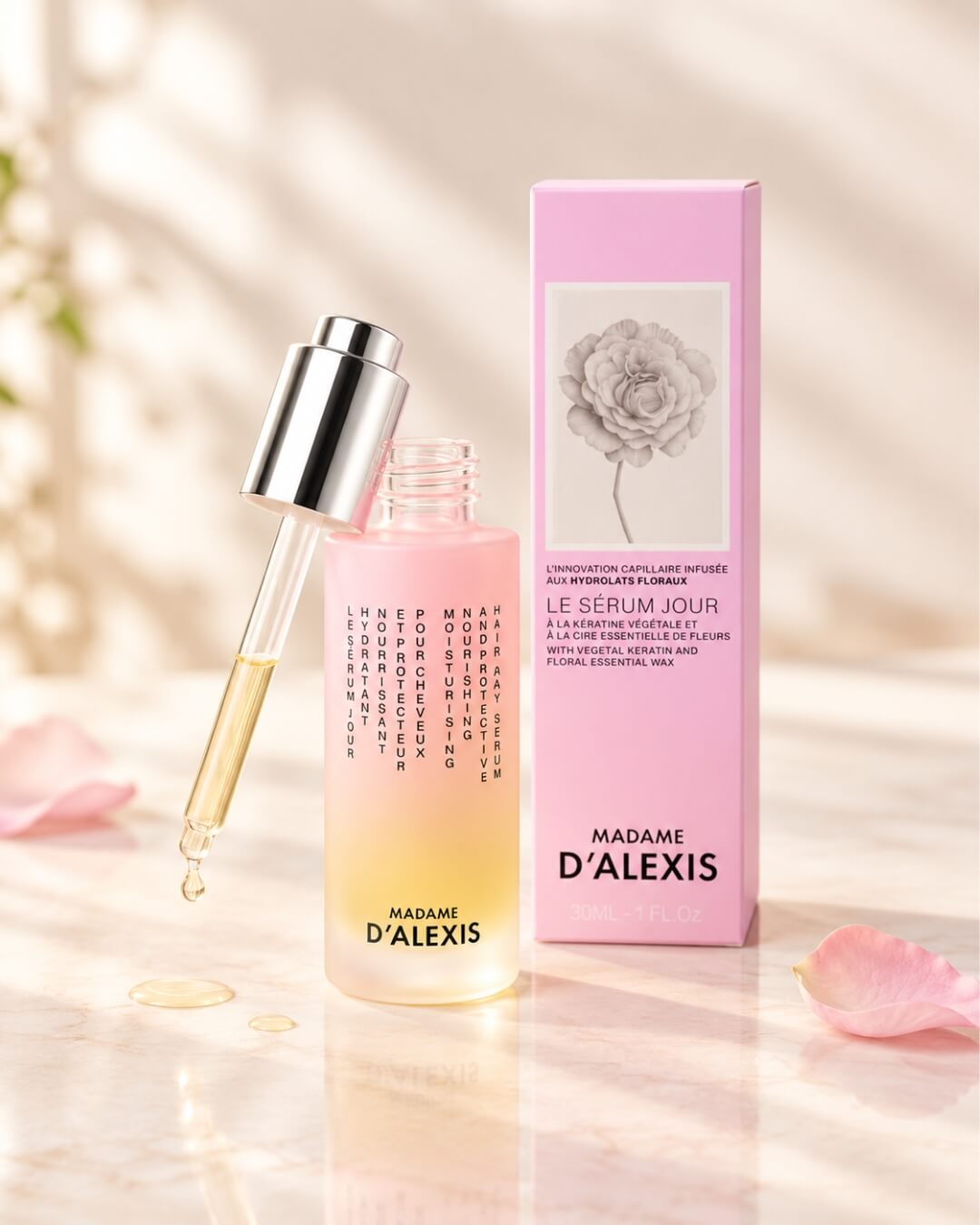
- The Madame d’Alexis Day Serum, silicone-free and 99% natural, acts as a heat shield up to 230°C.
- A consistent routine (moisturizing shampoo, nourishing mask, leave-in treatment, and temperature control) permanently limits heat damage.

The Day Serum
Heat protection · shine
- Heat and UV shield
- Anti-breakage ceramides
- Non-greasy
Why heat protection is essential to preserve the hair fiber
What does heat do to hair? Understanding heat damage
Heat instantly changes the internal structure of the hair. As soon as it reaches 150°C, the water naturally present in the hair fiber evaporates, causing rapid and often irreversible dehydration.
This lack of water weakens the cortex, the area responsible for strength and elasticity. The cuticles, which are supposed to protect the fiber, open under the effect of the temperature and create a rough surface where frizz can easily settle.
The damage caused by a heated device always manifests in the same way.
The most common signs are:
- a visible loss of shine;
- rough and brittle ends;
- hair that no longer retains moisture;
- a feeling of weakened hair fiber from the moment you style it.
It is a logical phenomenon: when the cuticles no longer play their role as a barrier, the fiber loses its ability to defend itself against heat and environmental aggressions.
Over time, the cumulative effects lead to dullness, then breakage.
What types of hair are most affected by a reaction to heat?
All hair types react to heat, but some are significantly more sensitive.
Dry hair, damaged, curly, and coily hair, naturally less coated by sebum, tends to burn more quickly. Colored or highlighted hair, whose structure has already been altered by chemical processes, requires increased vigilance.
Long and fragile hair also gets damaged more quickly, because its length increases the vulnerable areas. Even so-called “normal” hair eventually loses its suppleness without proper protection.
Why is a heat protectant treatment essential?
A good heat protectant treatment acts as a heat shield. It coats the fiber with a light film that limits the hair’s temperature rise and slows down the evaporation of internal water. This film also allows:
- to reduce breakage;
- to maintain hydration;
- to strengthen the natural barrier against UV, pollution, and overheating;
- to control frizz long-term.
It is a step as simple as it is essential: it directly conditions the health of the hair and the quality of the styling.
What products to use to protect your hair from heat
The best heat protectant products: what they must absolutely contain
An effective heat protectant relies on a precise composition. Certain ingredients are recognized for their protective properties:
- Organic jojoba oil: moisturizing and regulating, it limits water evaporation.
- Plant-based ceramides: they strengthen the protective barrier and improve cuticle cohesion.
- Natural heat-protectant active ingredients: they reduce the temperature rise during styling.
- UV antioxidants: they protect against free radicals generated by heat and pollution.
- Cationic hyaluronic acid: it permanently locks in hydration.
- Orange blossom wax: it seals water in the fiber and provides a smooth, shiny finish.
You can also find plant-based keratin, oil extracts, or castor oil, which strengthen the fiber and improve mechanical resistance.
The Day Serum
Heat protection · shine
- Heat and UV shield
- Anti-breakage ceramides
- Non-greasy
Heat protectant spray, cream, or serum: which one to choose?
Each format meets a distinct need.
The heat protectant spray dispenses a light mist suitable for fine hair or quick styling.
The heat cream offers more nourishing protection, often appreciated by dry or thick hair. It is an ideal protective treatment for dry hair.
The smoothing serum, meanwhile, combines precise application, shine, and a residue-free finish.
It is the most versatile product for controlled styling, especially when it contains natural ingredients capable of strengthening the fiber while protecting it.
How to apply a heat protectant for optimal effectiveness?
Application conditions 50% of the result.
On damp hair, the heat protectant makes drying easier and prevents heat shock. On dry hair, it accompanies the passage of the flat iron or curling iron. For a spray, it is essential to maintain a distance of about 20 cm so as not to saturate the fiber.
The quantity must be adjusted according to thickness, and the temperature of the devices set according to the hair type.
A consistent hair routine—gradual drying, moderate styling, and leave-in treatment—guarantees uniform and long-lasting protection.

How the Madame d’Alexis Day Serum protects hair from heat
A natural and professional heat protectant treatment, silicone-free
When looking for a truly effective heat protectant, the formulation becomes decisive. A good heat protectant treatment must limit the temperature rise of the fiber, prevent dehydration, and strengthen the hair’s natural barrier.
This is precisely the purpose of the Madame d’Alexis Day Serum. Its formula is based on 99% ingredients of natural origin, a point rarely reached in this segment, especially for a treatment capable of protecting up to 230°C, the common temperature of modern flat irons.
Its dry-oil texture, fine and silky, settles evenly without stiffening the hair or creating the glossy effect sometimes observed with silicone products.
This formulation choice allows hair to retain its lightness, even when it is fine or quickly weighed down. The serum also acts as an UV and anti-pollution shield, which extends heat protection beyond the simple use of a heated tool.
Finally, its leave-in format simplifies the routine: it can be used in the morning, for touch-ups, or just before styling, regardless of the hair type.
Focus on the heat-protectant ingredients of the Day Serum
Several key ingredients ensure the protective action. Each meets a specific need of the fiber:
- Organic jojoba oil: it moisturizes long-term and improves elasticity, which reduces the risk of breakage when heat is applied.
- Plant-based ceramides: they strengthen the cuticles, stabilize the protective barrier, and limit water loss.
- Essential orange blossom wax: it seals in the moisture and provides a natural shine without residue.
- Antioxidants: they neutralize free radicals generated by heat, the sun, or pollution.
- Natural heat-protectant active ingredient: it slows down the effects of the temperature rise on the fiber and prevents localized overheating.
The combination of these active ingredients creates a light film that protects without suffocating, a major advantage for already weakened hair.
How to use the Day Serum to maximize heat protection
The dosage conditions the effectiveness. A simple rule applies:
- Fine hair: 1 drop.
- Normal hair: 2 drops.
- Thick, curly, or coily hair: 3 to 4 drops.
Simply warm the product between the hands, then apply it to the lengths and ends.
Using it before hair drying, straightening, curling, or using a steampod creates a uniform barrier over the entire fiber. As a finishing touch, a micro-drop helps control frizz without weighing it down.

Complete hair routine to avoid heat damage
The 5 steps to protect your hair every day
Long-lasting protection relies on a consistent routine, structured around simple steps:
- Wash with a moisturizing shampoo to restore suppleness.
- Apply a nourishing mask once a week to strengthen the fiber.
- Use a leave-in treatment, such as the Day Serum, to maintain hydration and prepare hair for styling.
- Set the temperature of the heat styling tool, ideally between 150 and 180°C, depending on hair type.
- Finish with a light milk or mousse to set the hairstyle without making it stiff.
Ideal frequency according to your hair type
- Fine hair: light protection with every styling.
- Color-treated hair: use systematically to preserve color intensity.
- Curly or coily hair: enhanced routine, highly sensitive to heat.
- Dry or damaged hair: daily protection, even without heat styling tools.
- Normal hair: use before any direct heat source.
Use the Madame d'Alexis heat-protective Day Serum
FAQ — Everything You Need to Know About Heat Protection for Hair
What is the best heat protectant for hair?
The best heat protectant combines high heat protection, long-lasting hydration, and no heavy silicones.
Products containing jojoba oil, plant-based ceramides, antioxidants, and natural thermo-protective active ingredients offer superior results because they protect the hair fiber while strengthening it.
Professional-quality serums used before blow-drying, straightening, or curling often provide more even protection than a standard spray.
The key is to choose a formula capable of limiting the hair's temperature rise up to 200 to 230°C, the operating range of modern heat styling tools.
How to naturally replace a heat protectant spray?
There is no "homemade" equivalent as effective as a thermo-protective treatment formulated to withstand heat.
Some plant oils withstand higher temperatures than others, such as jojoba oil or grapeseed oil, but none create a uniform protective film comparable to that of a product developed for heat protection.
The only credible alternative is a natural serum enriched with thermo-protective active ingredients, capable of reducing internal water evaporation and preserving the fiber during styling.
Does heat protectant damage hair?
A well-formulated heat protectant does not damage hair; it does exactly the opposite. Without protection, the fiber undergoes rapid dehydration and cuticle lifting as soon as it reaches 150°C. With a heat protectant, a light film forms around the hair, limiting water loss and breakage.
The only formulas to avoid are those containing occlusive silicones that are difficult to remove, which cause buildup over time. A natural, silicone-free treatment remains the safest solution.
What to apply before straightening hair?
Before straightening, you must apply a leave-in thermo-protective treatment. The product should be distributed through the lengths and ends, never at the roots, to ensure even protection when using the iron.
It is possible to straighten damp hair after applying a suitable product, but most styling tools require completely dry hair to prevent thermal shock. A light serum provides shine, glide, and protection, which improves the final result.
What temperatures should not be exceeded?
The reasonable limit depends on hair type.
- Fine or fragile hair: 140 to 160°C.
- Normal hair: 160 to 180°C.
- Thick or curly hair: 180 to 200°C maximum.
Beyond that, the fiber dries out very quickly, even with protection. Straighteners displaying 230°C should only be used occasionally and exclusively with a high-performance thermo-protective treatment.
How to protect color-treated hair from heat?
Color-treated hair is particularly sensitive because coloring weakens the fiber and opens the cuticles more easily. To preserve color intensity, you should:
- use a heat protectant rich in antioxidants to limit oxidation;
- incorporate a moisturizing routine with a weekly mask;
- avoid excessive heat and space out straightening sessions;
- opt for a thermo-protective serum that seals in moisture and prevents color from fading due to heat and UV rays.
How to protect my hair from heat?
Heat protection for hair is based on a simple principle: prevent the hair fiber from reaching too high a temperature when using a heat styling tool. To do this, apply a heat protectant spray, a thermo-protective treatment, or a heat protectant before using a straightening iron, curling iron, or hair dryer.
Long, dry, damaged, coily, or curly hair is particularly sensitive to heat damage because its structure retains water less effectively.
A leave-in treatment forms a light film that slows the temperature rise and limits internal water evaporation. Applied to the lengths and ends, it protects the hair fiber, reduces the risk of breakage, and preserves suppleness.
Protection should be renewed with every styling, even when using so-called “temperature-controlled” devices.
What are the best products for hair?
The best heat protectants combine hydration, repair, and long-lasting protection.
A thermo-protective spray is convenient for fine hair and quick styling; a smoothing serum or a repair treatment enriched with jojoba oil, plant-based keratin, or natural active ingredients provides more comprehensive protection for color-treated, damaged, or dry hair.
A good hair range combines several types of products:
- a nourishing mask to strengthen the fiber;
- a thermo-protective cream to smooth and soften;
- a protective serum for finishing;
- a natural product rich in moisturizing active ingredients to maintain shine.
Combining these treatments improves the hair's resistance and quality over time.
What types of hair need protection?
In reality, all hair types should benefit from heat protection. Long hair, coily hair, curly hair, dry hair, or damaged hair are the most vulnerable because their hair fibers are less uniform and dry out more quickly.
Color-treated hair also requires enhanced protection to prevent oxidation and pigment loss. Even normal and fragile hair reacts to heat: regular exposure without treatment can be enough to damage the surface.
How to use a thermo-protective spray?
A thermo-protective spray should be applied evenly. On damp hair, it makes drying easier; on dry hair, it prepares it for the straightening iron or curling iron. Maintain a safe distance of about 20 cm to avoid saturating the fiber. Then, detangle to distribute the product.
Styling with a hair dryer or heat styling tool should always be done after applying the treatment, as part of a consistent hair care routine. This limits heat damage and ensures even protection.
What ingredients are effective for protecting hair?
Certain ingredients are recognized for their heat-protective properties:
- Plant-based keratin: strengthens the fiber;
- Citric acid: balances the pH, smooths the cuticles;
- Jojoba oil: long-lasting hydration, anti-breakage effect;
- Natural oil extracts: nourishment and suppleness;
- Natural or organic hair active ingredients: heat protection and repair;
- Nourishing components: hyaluronic acid, ceramides, plant oils.
A good formula combines hydration, repair, and a protective barrier to limit heat-related damage.
What are the benefits of a heat protectant?
A heat protectant offers several major benefits:
- heat protection;
- reduced breakage;
- strengthened hair fiber;
- creation of a light protective barrier;
- reduced static electricity;
- cleaner straightening and increased shine;
- maintenance of healthy, strong hair during styling.
It is an essential hair care product for preventing invisible damage that accumulates over time.
Where to buy heat-protective treatments?
You can buy protective treatments in salons, boutiques, stores, or on specialized e-commerce sites.
Many products, including thermo-protective sprays and natural serums, are available online with delivery, often to a pickup point.
Promotional periods allow access to quality treatments at a favorable price, sometimes grouped in a set or as a gift offer. An online order generally offers a wider selection and detailed advice on compositions and uses.