


Crème solaire sur les cheveux : protéger ses longueurs sans les alourdir
Oui, on peut appliquer une crème solaire sur les cheveux, mais en suivant un protocole précis. L'objectif : protéger la fibre, la raie et les pointes sans créer d'effet gras, sans cartonner les longueurs et sans oublier la réparation du soir.
L’essentiel à retenir avant l’exposition
- Les filtres d’une crème solaire cutanée protègent, mais leur texture riche colle sel et sable ; optez plutôt pour un spray ou une huile sublimatrice protectrice SPF 30 - 50.
- Spray 15 cm away from the parting, ends, and around the ears; a small amount is sufficient for medium-length hair.
- Reapply every two hours and after swimming to maintain protection.
- In the evening, gently shampoo twice and then apply a nourishing mask: this will remove any residual filters while replenishing the hair fiber with moisture.
We think about protecting our skin, checking every inch of it before our first sunbathing session... but what about our hair?
Under the sun, hair fibers undergo accelerated aging: oxidation of keratin, photodegradation of pigment, and internal dehydration.
My grandmother, Madame d'Alexis, who always brought back a bottle of apricot kernel oil from her summer markets, used to tell me that "burnt hair doesn't grow back any better than burnt grass." That's how important it is to have clear answers to this question. So, how should you take care of your hair in summer?
Sérum Jour et Sérum Nuit : le duo été pour protéger et réparer
Une routine courte et cohérente avec la charte Madame d’Alexis : le Sérum Jour pour protéger les longueurs avant l’exposition, le Sérum Nuit pour accompagner le cuir chevelu et la fibre le soir après soleil, sel, chlore ou chaleur.
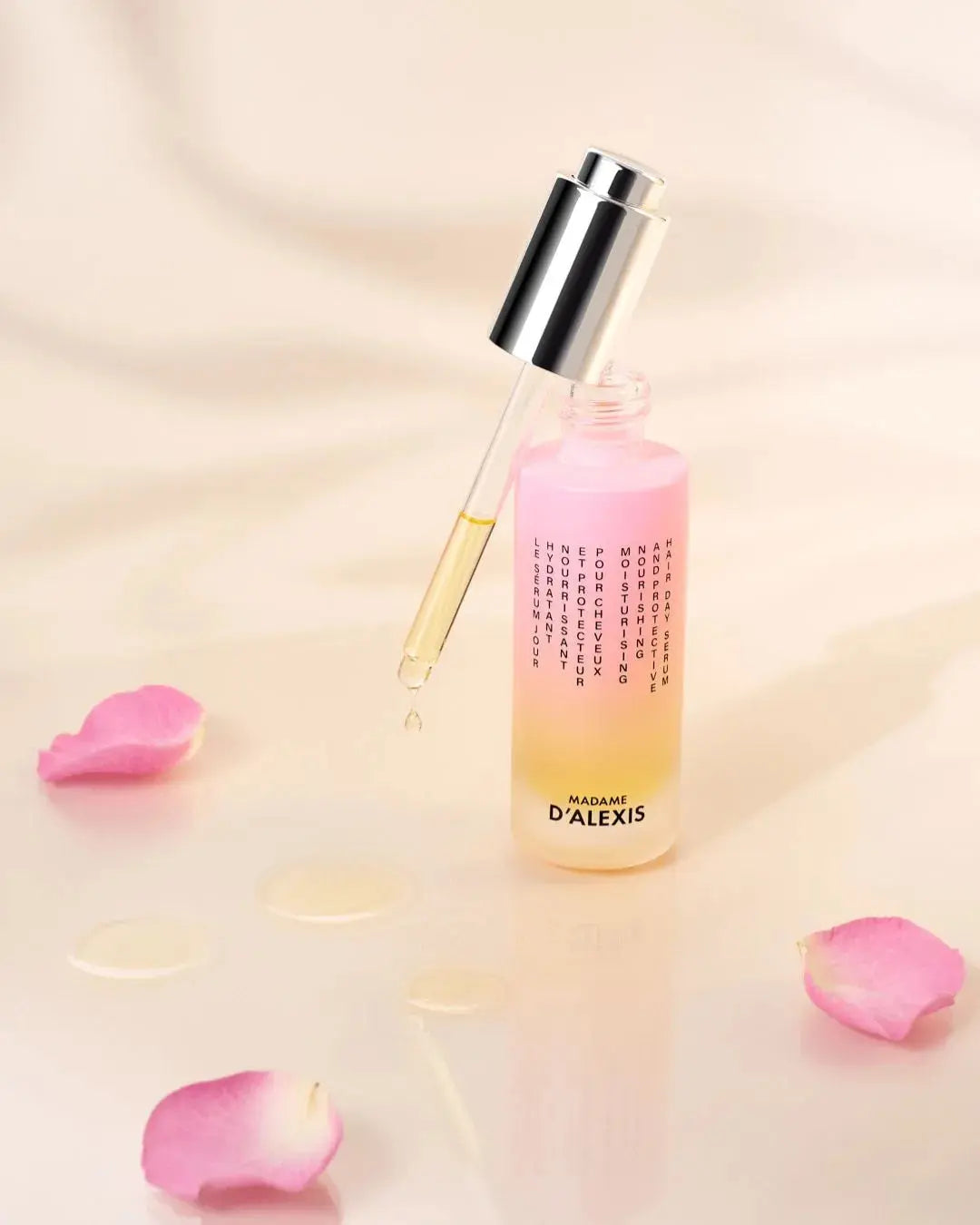
The Day Serum
Thermoprotection · UV · anti-frisottis
- Protège chaleur, UV et pollution
- Céramides végétales et huile de jojoba
- Finition brillante sans effet gras
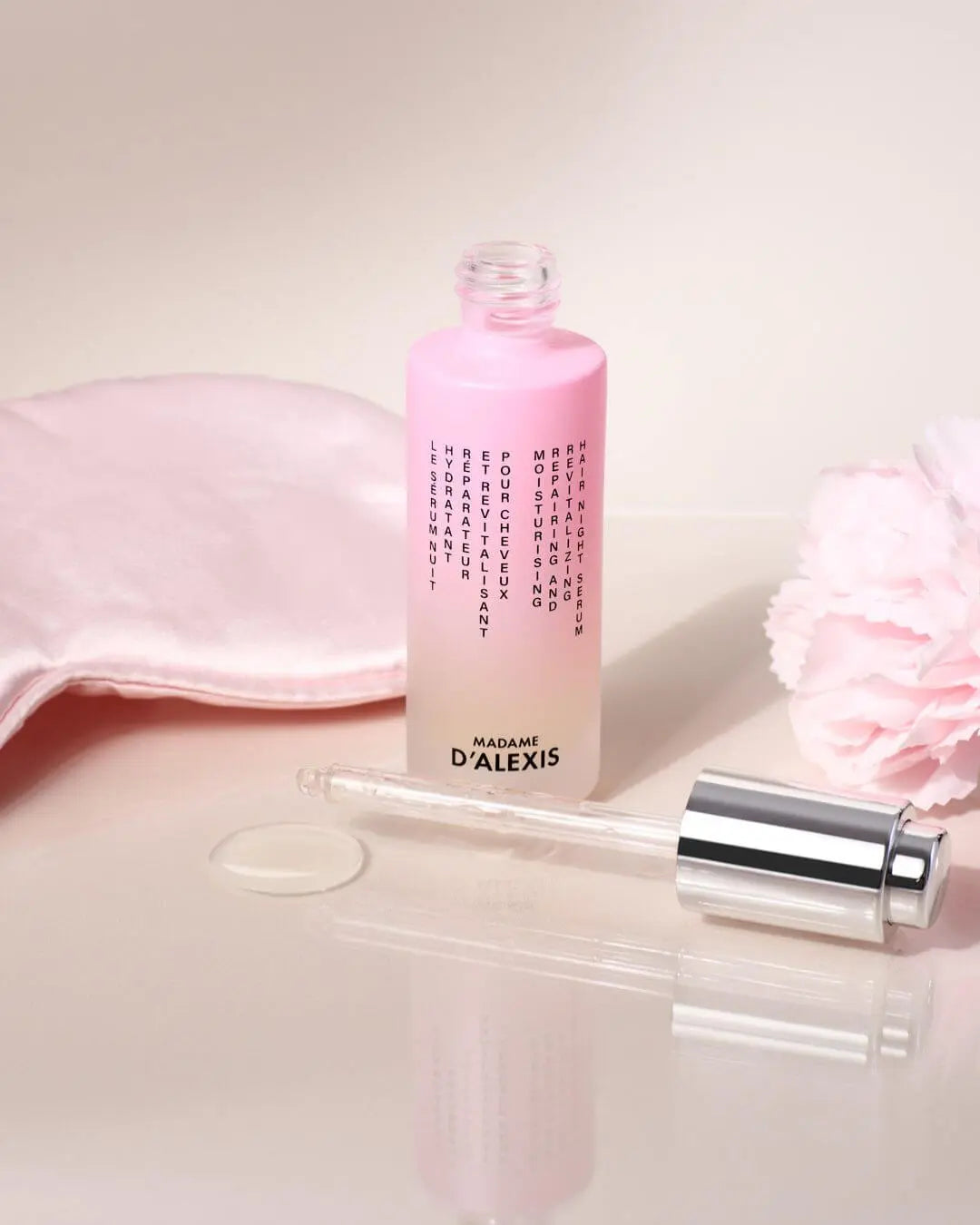
Night Serum with Hydrolats
Probiotiques · hydrolats bio · densité
- Application le soir, raie par raie
- Aide à rééquilibrer le cuir chevelu
- Idéal après soleil, sel ou chlore
Why does the sun damage hair?
UVA rays penetrate deeply and weaken keratin, while UVB rays break disulfide bonds, causing breakage and dullness. Add salt, chlorine, and heat to the mix: water evaporates, the cuticle opens, and the color turns coppery. The result:
- dryness of touch;
- loss of shine;
- irreversible discoloration, especially on blonde or bright red highlights.
What are the effects of the sun on hair?
A British study shows a 25% reduction in hair's mechanical strength after 30 hours of exposure to simulated African sunlight: proof that photodegradation is not just a cosmetic concern.
Can sunscreen be applied to the hair?
Yes, but with discernment. UV filters remain effective on the hair shaft; however, their formulation is not designed for hairstyles. Rich emulsions, strong fragrances, and film-forming agents can weigh down the roots or leave a "stiff" finish.
It is best to reserve the cream for the roots or thinning areas, then use a protective spray formulated for the hair fiber on the lengths.
Skin vs. Hair: The Essential Differences
- Filters: organic or mineral, identical, but with a lower dosage on the capillary side.
- Textures: thick cream versus light mist or protective hair oil.
- Fragrances: allergen-free for sensitive scalps.
What happens if sunscreen gets on your hair?
A greasy film blocks light but can trap salt and dust; rinsing in the evening is essential.
Can sunscreen stain or change hair color?
Yes, in the presence of avobenzone: this filter, combined with hard water, oxidizes pigments and leaves an orange tint. Platinum blondes are familiar with this "copper flash" effect.
Can sunscreen cause hair loss?
Rest assured: no studies have established a direct link. Only certain perfumes or alcohols can irritate an already sensitive scalp, causing temporary reactive hair loss. An alcohol-free, pH-neutral spray eliminates this risk.
Protecting your hair from the sun isn't just a whim; it's a preventive, elegant, and informed gesture, like wearing a Panama hat on a terrace in Portofino.

Spf capillaire : mythe ou réalité ?
Long confined to the backstage of photo shoots, sunscreen for hair is now making its mark on beach towels. Yes, hair SPF does indeed exist: featherweight emulsions, satiny dry oils, and two-phase serums that leave barely a trace on the hair fiber.
Their promise? To filter UVA and UVB rays while leaving hair silky smooth. Dr. Nina Roos, a Parisian dermatologist renowned for her work on photoprotection, points out that "even a light filter reduces surface lipid oxidation by nearly 30% after three hours of exposure."
For consumers, the benefits are clear to see: preserved shine, intact softness, and a subtle fragrance rather than a cubicle smell.
Key strengths:
- Invisible finish; no chalky residue on dark hair;
- nutrient complex (prickly pear oil, camellia oil, vitamin E) that soothes dry hair;
- Hydroalcoholic formulation to avoid weighing down the roots.
Can I use regular sunscreen on my hair?
Yes, as long as you remain pragmatic. Body cream provides effective protection, but its rich emulsion sticks to sand, oxidizes more quickly, and leaves a dull film on the hair.
Apply it to the parting or temples when your scalp has thinning areas; for the lengths, opt for a spray designed for the hair fiber. This will help you avoid the infamous "cardboard effect" in the evening, an unflattering reminder of the monoi years.
Can sunscreen be used as hair gel?
In theory, the emulsion will slightly fix the hair. In practice, the hold remains mediocre, the waxy appearance is visible, and the alcohol in some formulas dries out the ends.
It's better to use a protective veil + a salt-free setting mist; your high bun will hold better and your hair will be softer.
How can you effectively protect your scalp from the sun?
Since the skin on the scalp is as thin as that on the eyelids, it deserves its own specific strategy.
- Hat: wide brim (minimum 7 cm), tightly woven, light color to reflect heat.
- Silk scarf: tied in a turban style, it reduces direct UV exposure to the hairline by 90%.
- Zigzag line: this pattern disperses the radiation and limits targeted sunburn.
- Leave-in SPF: spray directly onto the parting line and massage in with your fingertips.
How to moisturize your hair in the sun?
Radiation accelerates the evaporation of internal water, so opt for light occlusive textures:
- Aloe vera and glycerin mist before exposure;
- protective oil to enhance the skin after each swim;
- marula oil bath in the evening to replenish the lipid cement.
How can Madame d'Alexis' leave-in day serum protect hair from the sun and replace sunscreen?
Instructions for use: apply, reapply, remove
SPF 30 à 50 pour exposition prolongée, filtre minéral si vous portez une coloration végétale, formule waterproof en cas de baignade.
L’équivalent d’une noisette sur cheveux mi-longs, à vaporiser à 15 cm puis à peigner pour uniformiser.
Toutes les deux heures ou après chaque baignade, sans oublier les contours d’oreille et la nuque.
Remove sunscreen without damaging your hair
- double gentle shampoo: first wash to dissolve sunscreen, second wash to purify;
- nourishing mask enriched with ceramides for ten minutes;
- Final rinse with cool lemon water to tighten the cuticle and neutralize salt residue.
Taking care of your hair means planning ahead: just as you would slip a hardcover book into your shopping bag, you should now carry hair SPF with you. Your locks will thank you, with a pearlescent shine that will last all summer long.
Poudre solaire cheveux : la protection invisible pour la raie
La poudre solaire cheveux est le format le plus discret pour protéger la raie et le cuir chevelu sans alourdir les racines. Idéale pour les cheveux fins ou les crânes dégarnis, elle s'applique directement sur la raie avec un pinceau ou un applicateur, laisse un fini mat et invisible.
SPF 30 à 50 selon les formules. À renouveler toutes les 2 heures comme n'importe quel filtre solaire.
Le Sérum Nuit Madame d'Alexis complète ce geste le soir : appliqué sur le cuir chevelu après exposition, il répare le microbiome cutané fragilisé par les UV et la chaleur.
Sunscreen on hair: all the answers to your key questions
Qu'est-ce qu'une brume solaire cheveux ?
La brume solaire cheveux est un spray léger formulé pour la fibre capillaire, contrairement à la crème solaire cutanée, elle ne colle pas, ne laisse pas de résidu gras et peut se ré-appliquer sur cheveux secs sans alourdir les racines. SPF 30 minimum recommandé pour une exposition prolongée en plein soleil. À compléter le soir avec un soin réparateur sur le cuir chevelu.
Can I put sunscreen on my hair?
Yes, but choose a formula without alcohol or octocrylene; rinse and moisturize in the evening to prevent dryness and dullness.
Can I use regular sunscreen on my hair?
As a temporary solution: limit yourself to the parting and massage. On the lengths, opt for a light hair spray so as not to weigh down the hair fiber.
What happens if sunscreen gets in your hair?
It creates an oily film that traps salt and dust; on light blond hair, avobenzone can turn coppery. Wash your hair as soon as you get back from the beach.
Can sunscreen stain hair?
Yes, especially on colored hair: avobenzone + hard water = orange tones. Rinsing with filtered water or vinegar reduces the risk.
Can sunscreen be used as hair gel?
Weak hold, dry ends. It is better to use a salt-free fixing spray after applying your SPF protection.
How to moisturize your hair in the sun?
Before exposing hair to the sun: aloe vera mist + glycerin. While exposing hair to the sun: protective enhancing oil. After exposure: moisturizing hair mask rich in ceramides, leave on for ten minutes.
Is SPF for hair something that exists for hair?
Yes: SPF 30-50 mists, mineral powders for the hairline, filtering oils. A light filter reduces lipid oxidation by 30% (Dr. Nina Roos).
Can sunscreen cause hair loss?
No, unless you have an allergic reaction. Choose hypoallergenic, pH-neutral formulas; rinse sensitive scalps thoroughly.
How can you protect your scalp from the sun?
7 cm brim, zigzag stripe, mineral SPF powder, reapply every 2 hours or after swimming.
Can sunscreen change the color of your hair?
Yellowing or copper highlights possible; if discoloration occurs, use "anti-UV color" sprays and rinse with fresh water.
What are the effects of the sun on hair?
Oxydation lipides, rupture ponts disulfure, cassure ; -25 % de résistance après 30 h d’exposition simulée.
Why does my hair turn orange when I put sunscreen on it?
Reaction between avobenzone and iron/copper ions in hard water. Solution: mineral filter or rinsing with low-mineralized water.
How do I remove sunscreen from my hair?
Double lavage doux, gommage cuir chevelu, eau tiède ; finissez par un jet froid pour resserrer la cuticule.
What sun protection should you use for your hair?
Pour protéger les cheveux efficacement, choisissez un produit en fonction de votre usage : brume SPF 30 sans alcool en ville, crème solaire fluide SPF 50 pour une exposition prolongée, ou huile sublimatrice protectrice cheveux pour nourrir et filtrer les UV en une seule gestuelle.
Should you apply sunscreen to your hair?
Yes: parting, temples, light tips. Otherwise, use a dedicated spray + hat. Repeat every 2 hours.
How can you protect your hair from the sun?
3-step routine: before (SPF spray), during (reapplication), after (repairing mask).
What are the risks to hair in the sun?
Sunburn, dry hair, discoloration, loss of shine. Regular protection prevents this damage.
How do you apply sunscreen to your hair?
Vaporisez à 15 cm, massez légèrement, évitez racines grasses, renouvelez toutes les 2 h.
Why use sun protection for your hair?
It preserves the fiber, limits breakage, maintains color, and prevents UV-induced inflammation of the scalp.
What type of sunscreen should you use on your hair?
Pour chaque type de cheveux, la protection doit être calibrée : spray aérien SPF 30 sur cheveux fins, huile lactée SPF 50 sur cheveux épais ou bouclés, formulation minérale sur cheveux colorés, lotion légère SPF 50+ sur cuir chevelu sensible.
Protéger le jour, réparer la nuit
Pour une routine solaire cohérente : le Sérum Jour aide à protéger les longueurs avant l’exposition, le Shampoing et le Masque retirent les résidus le soir, puis le Sérum Nuit accompagne le cuir chevelu après soleil, sel et chlore.
Discover the Day Serum
