Conseils
My hair has stopped growing: understand the causes and jumpstart growth
Long hair on a coffee break? Discover why your hair has stopped growing, identify deficiencies or micro-breakage, and adopt a sophisticated routine—gentle shampoo, overnight serum, targeted nourishment—to jumpstart growth.

What should I do if my hair stops growing?
- Identify the cause: iron or zinc deficiency, hormonal stress, irritated scalp – the diagnosis points to 80% of the solution.
- Use a gentle shampoo without sulfates or silicones to limit invisible breakage that gives the illusion that hair "doesn't grow".
- Nourish the roots: night serum enriched with fine floral waters and cationic hyaluronic acid, applied section by section, activates the anagen phase.
- Stimulate microcirculation: five-minute daily massage, head tilted, to irrigate the bulb and restart hair growth.
- Support from within: diet rich in protein and omega-3, biotin-methionine supplements for three months to permanently lengthen the fiber.
Night serum for hair growth: what is the best serum and how to apply it?
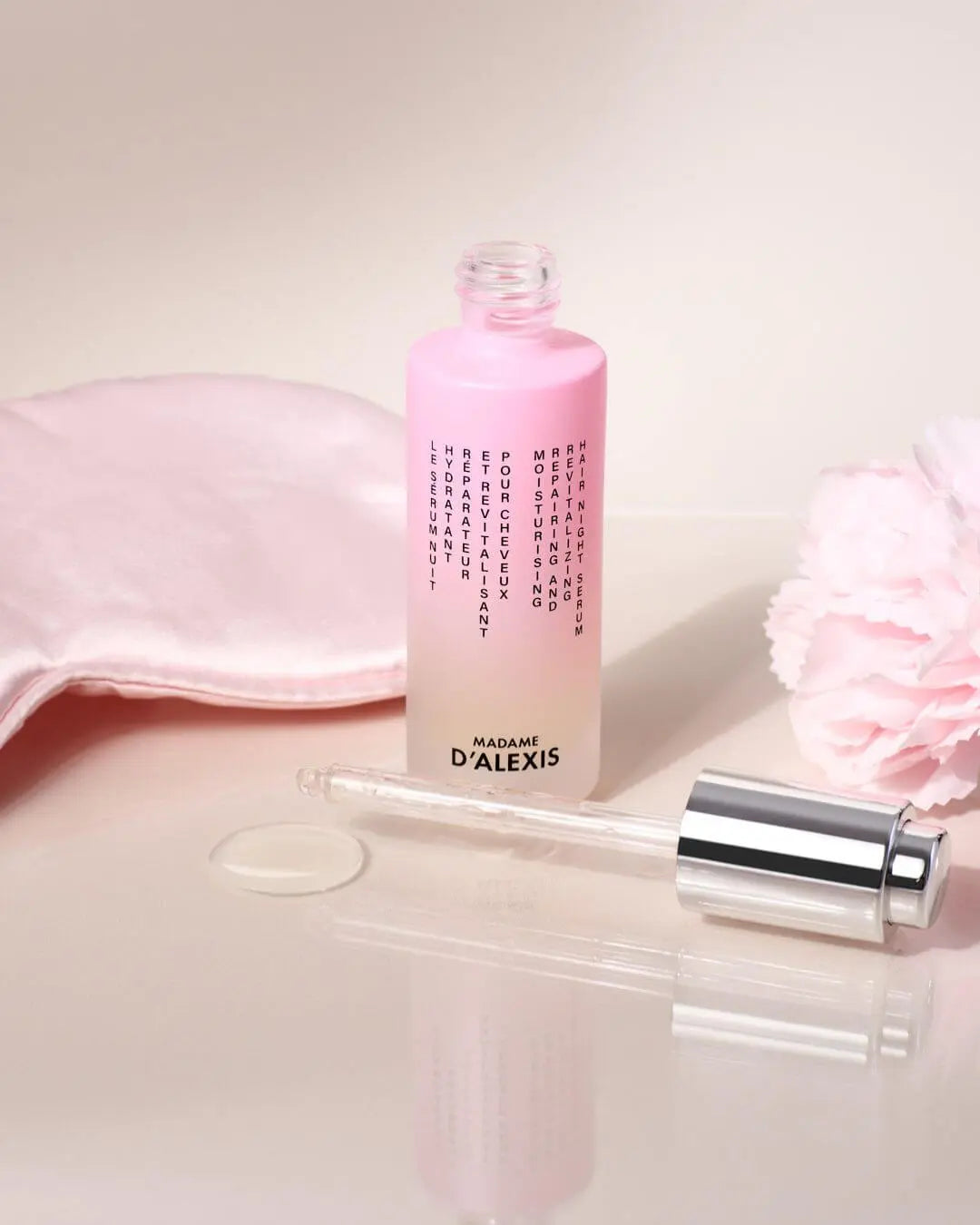
The Night Serum with Floral Waters
Organic floral waters · Nettle · Licorice · Leave-in routine
- Helps create an environment conducive to stronger hair
- Supports weakened scalps or those lacking density
- Leave-in treatment to incorporate into a regular growth routine
Key growth actives: what to look for on the label
| Active | Role | Where to find it |
|---|---|---|
| Nettle | Stimulates the bulb's microcirculation | Night serum |
| Licorice | Locally inhibits DHT | Night serum |
| Castor oil | Ricinoleic acid → circulation | Mask, pre-shampoo oil |
| Rosemary | Natural vasodilator (2015 study vs minoxidil) | Serum, oil |
| Biotin | Keratin cofactor | Dietary supplement |
| Cationic HA | Deep hydration without weighing down | Madame d'Alexis Night Serum |
Hair growth cycle: why the anagen phase shortens
The three phases of hair growth: anagen, catagen, telogen
Under your scalp, a cellular opera is taking place: the long anagen phase makes the shaft grow about 1 cm per month; followed by the catagen interlude, when the bulb retracts; finally the telogen, where the hair gently detaches. Normally, 85% of the hair is in anagen – that's the ratio of healthy growth.
How to know if my hair is no longer growing normally?
- Length stagnates despite rare cuts.
- Ends that fray as soon as you touch them.
- Ponytail circumference that loses a centimeter in a quarter.These signs indicate a premature transition to the telogen phase; it is then appropriate to look for the underlying obstacle.

Growth rate according to hair type
Growth is not universal: Caucasian hair grows about 1.2 cm/month, Asian hair reaches 1.5 cm/month thanks to a wider follicle, while curly and coily hair, whose helical shaft retracts up to 70% of its actual length, often gives the illusion of stagnating when it is actually growing normally.
Knowing your baseline rate prevents confusing slow growth with no growth.
What blocks hair growth: deficiencies, hormones, scalp
Nutritional deficiencies: iron, zinc, biotin, vitamin D
The follicle, with its extreme voracity, suffers as soon as a trace element is missing. Ferritin below 50 µg/L slows down the matrix; biotin, meanwhile, catalyzes keratin synthesis.
Hormonal imbalances: thyroid, DHT, postpartum, menopause
A simple thyroid imbalance drops the bulb's metabolic energy; excess DHT miniaturizes the hair down to fuzz. After childbirth or at the dawn of menopause, the distribution of phases is disrupted, and growth freezes.
Chronic stress and emotional shocks
Cortisol prematurely closes the capillaries of the scalp; I saw, after a merger-acquisition, a female executive lose 30% of her density in six weeks.
Scalp conditions
Dermatitis, psoriasis, or dandruff thicken the stratum corneum; the root suffocates. A gentle scrub often unlocks the situation.
Bad hair practices
Flat irons at 200°C, repeated bleaching, excessively tight braids: all lead to micro-breakage that prevents reaching the dream length.
Seasonal factors and aging
In autumn, the hair pays for the summer excess of light; past forty, the anagen phase naturally shortens.
Curly and coily hair: retraction as a false absence of growth
For curly, coily, or kinky hair, the spiral of the shaft absorbs up to 70% of the produced length: a hair that has grown 3 cm visually "measures" only 1 cm longer.
This retraction phenomenon is the leading cause of discouragement. The solution is not to stimulate growth further, but to preserve the length: protective hairstyles (loose braids, buns), enhanced hydration, minimal handling.

Hair growth diagnosis: self-check and targeted blood test
Self-check
List: density at the temples, shine, elasticity. Photographing the center part every month is an implacable revealer.
Targeted blood test
Iron, B12, zinc, TSH: four analyses that illuminate 80% of growth slowdowns.
Specialist consultation
A dermatologist or trichologist will confirm, through dermoscopy or a small biopsy, whether it is effluvium or androgenetic alopecia. From there, a tailor-made protocol – peptide night serum, precise supplementation, LED sessions – can give your hair back the momentum it deserves.
Restarting hair growth: natural 5-step protocol
Adapting the hair routine
-
Sulfate-free shampoo: why it preserves growth
I often invite my clients to compare their hair to cashmere: an inopportune trip through the washing machine is enough to ruin the fiber. Prefer a surfactant of coconut origin to wash without stripping. -
Night growth serum: fine floral waters, cationic hyaluronic acid, and synergized probiotics
Apply three drops, section by section; Damask rose rehydrates and polishes the fiber, matricaria chamomile soothes the scalp, while orange blossom gives a renewed energy to the dormant bulbs. Hyaluronic acid, in its cationic version, attaches to porous areas to coat without weighing down; probiotics, meanwhile, rebalance the nighttime microbiome. In the morning, the strand gains hold, the root serenity, as if a discreet spa had worked during your sleep. -
Scalp scrub once a month
A brown sugar scrub removes pollution residue from the follicles; oxygen returns, the anagen phase catches its breath.
Stimulate microcirculation
Five minutes of digital massage, head tilted toward the heart: it's an espresso for the bulb. On busy days, the inversion technique (hair toward the floor for thirty seconds) is enough. Finish with a pneumatic brush; the wooden bristles activate without aggressing.
Place the 10 fingers flat on the scalp, apply small circular movements without sliding (the scalp must move, not the fingers). Progress from the neck toward the forehead. 5 minutes, 3 to 4 times a week. Optionally: the 0.25 mm dermaroller once a week stimulates vascularization without pain.
Nutrition and hair growth: iron, zinc, protein
-
Foods to make hair grow
| Food | Key nutrient | Growth benefit |
|---|---|---|
| Lentils, black pudding | Iron | Bulb oxygenation |
| Oysters, Brazil nuts | Zinc | Keratin synthesis |
| Salmon, flax seeds | Omega-3 | Follicular anti-inflammation |
| Eggs | Biotin + protein | Shaft structure |
| Avocados | Vitamin E | Oxidative protection |
-
Supplement course (3 months minimum): iron, zinc, methionine
Below 50 µg/L ferritin, growth stalls; adjust before blaming genetics.
Limit breakage to preserve length
-
Maintenance cut every 10 – 12 weeks
A light bob with tapered ends is enough to remove what I call "the fatigue fringe". -
Heat protection and silk pillowcase
Silk reduces nighttime friction by 43%; your lengths thank you upon waking.
Re-evaluate and adjust after three months
Photograph your center part, measure the ponytail circumference; then adapt the course or intensify the massage. Hair, like a vine, responds to measured and regular care.
Prevention: 3 habits for continuous hair growth
Adapted washing rhythm and lukewarm water
Two washes per week are enough; beyond that, sebum takes its revenge and the fiber dries out.
UV protection and antioxidants in summer
A hair SPF veil and a pomegranate spray neutralize free radicals; I like to compare this tandem to an invisible umbrella.
Stress management: sleep, meditation, regular physical activity
Cortisol is the silent enemy of the bulb. Eight hours of sleep, fifteen minutes of coherent breathing, and a daily walk reset the scalp like restarting a tired server. Your hair then charges, day after day, with a vigor that simple cosmetics cannot imitate.
The Night Serum special for hair growth
Organic floral waters · Nettle · Licorice · Leave-in routine
- Helps create an environment conducive to stronger hair
- Supports weakened or thinning hair
- A leave-in treatment to incorporate into a regular growth routine
FAQ: Hair growth: all the answers
Why isn't my hair growing anymore?
When you notice that your hair isn't growing anymore, it is rarely a lost cause. Hair growth depends on a well-vascularized scalp; however, if the hair becomes dry due to a lack of sebum or internal hydration, the fiber breaks before it even has time to grow.
Result: your hair doesn't grow and the growth of your hair seems to have stalled.
In some people with long hair, constant micro-breakage gives exactly the same impression: the hair doesn't grow while it shortens at the ends.
A targeted supply of iron, zinc, and protein, combined with regular massages, restarts the matrix and allows the lengths to grow again.
In practice:
- ferritin levels below 50 µg/L slow down the growth of your hair;
- an irritated scalp hinders vascularization, and the hair doesn't grow;
- weakened ends break, creating the illusion that the hair isn't growing anymore when it is actually shortening due to micro-breakage.
Rebalancing nutrition, hydration and circulation restores the desired length, step by step.
What are the causes of hair loss?
Hair loss is caused by a range of factors:
- androgenetic alopecia (hormonal sensitivity to DHT);
- alopecia areata (autoimmune mechanism);
- nutritional deficiency in iron, zinc, or vitamin D due to a poor diet;
-
health condition or hormonal stress (postpartum, menopause).
The genetic imprint determines the intensity of the phenomenon; a medical diagnosis remains the first step.
How to stimulate hair growth?
To stimulate growth:
- gently warm some castor oil, massage the scalp for five minutes;
- in your hair routine, apply the shampoo gently, then a thickening serum;
- dietary supplements: biotin, methionine, zinc for three months;
- a balanced diet rich in plant-based proteins promotes vitality.
These combined steps help grow your hair longer and stronger.
What treatments promote hair growth?
- Prefer natural treatments based on premium hydrosols;
- choose a thickening shampoo without sulfates;
- opt for a serum to apply in the evening, rich in peptides;
- add weekly hair masks for hydration.
Curly hair and coily hair will gain resilience, while long hair will retain its fluidity.
How to prevent hair breakage?
The fiber breaks when your hair breaks due to repetitive micro-breakage. Weak hair is particularly sensitive to this; a poor lifestyle (stress, fragmented sleep, dehydration) further weakens the keratin. To preserve the integrity of the hair shaft:
- avoid hair products containing alcohol that leave the hair damaged;
- limit heat, prefer lukewarm air at 60°C;
- schedule a session to trim your ends every three months: you remove the porous part and immediately stop the spread of the axial crack.
By combining a nourishing treatment, preventive trimming, and a balanced lifestyle, the surface of the hair remains smooth; the length is maintained without mechanical loss.
What is the hair growth cycle?
The hair cycle alternates between three stages:
- anagen phase – growth;
- catagen phase – bulb rest;
- telogen phase – programmed shedding.
If the proportion of anagen falls below 80%, hair growth slows down; you will then notice that the hair grows more slowly or even seems to stop growing.
What foods are good for hair health?
A healthy diet prevents nutritional deficiencies:
- B vitamins (brewer's yeast, eggs);
- iron (lentils, black pudding);
- zinc (oysters, Brazil nuts);
- essential fatty acids (wild salmon, flaxseeds).
These premium choices nourish the hair from within, a prerequisite for abundant, long-lasting hair.
Why doesn't my hair grow in certain areas?
Localized thinning areas are often caused by mechanical traction – a ponytail tied too tightly – or early alopecia areata; a dermatologist can confirm this through dermoscopy.
What are the signs of active regrowth?
Slight itching, fine light hair at the root, and increased density to the touch; patience is a virtue here.
Do you really need to cut your hair to make it grow faster?
Cutting does not make hair grow; however, removing breakage preserves every millimeter gained: a trim every three months remains strategic.
What condition can stop hair growth?
Thyroid conditions (Hashimoto's, Graves') and severe iron-deficiency anemia are the most common obstacles; medical treatment can then restore growth.