


Vos cheveux manquent de brillance, de souplesse, de vie ? Vous avez essayé des masques classiques sans résultats durables ? Vous cherchez une solution vraiment efficace, naturelle et durable ?
Le choix du masque capillaire est crucial. Un mauvais masque peut alourdir vos cheveux, les laisser ternes ou gras. Un bon masque transforme votre chevelure en 2-3 semaines.
Mais comment choisir le meilleur masque cheveux parmi les centaines de produits disponibles ? Quels critères regarder ? Quels ingrédients privilégier ? Quel masque convient vraiment à votre type de cheveux ?

Cet article répond à toutes vos questions. Vous découvrirez :
- Les 5 critères pour identifier un vrai bon masque
- Pourquoi le Masque aux Hydrolats Madame d'Alexis surclasse les alternatives
- Un protocole 30 jours pour transformer vos cheveux
- Les erreurs courantes à éviter
- Une FAQ complète pour tous vos doutes
Résultat attendu : Cheveux transformés en 30 jours — plus brillants, plus souples, plus volumineux, plus sains.
Les 5 critères pour identifier le meilleur masque cheveux
Avant de vous recommander un produit, il faut d'abord comprendre ce qui fait un vrai bon masque capillaire. Voici les 5 critères essentiels :
1. Composition sans ingrédients agressifs
Un bon masque doit être sans sulfates, sans silicones, sans parabènes.
- Sulfates : décapent la fibre et irritent le cuir chevelu
- Silicones : créent une fausse brillance qui s'accumule et étouffe les cheveux
- Parabènes : perturbateurs endocriniens, irritants à long terme
✓ À privilégier : Hydrolats naturels, huiles végétales, acide hyaluronique, kératine végétale, prébiotiques.
2. Actifs hydratants et réparateurs réels
Un bon masque ne doit pas juste "sentir bon". Il doit contenir des actifs qui agissent vraiment :
- Acide hyaluronique : hydrate en profondeur, repulpe la fibre
- Kératine végétale : renforce la structure interne, réduit la casse
- Hydrolats floraux : apaisent, régénèrent, apportent brillance naturelle
- Huiles végétales légères : nourrissent sans alourdir (jojoba, argan, coco)
- Prébiotiques : nourrissent la flore cutanée, stabilisent le microbiome
❌ À éviter : Eau inerte (dilution), parfums synthétiques, conservateurs agressifs.
3. Texture adaptée à votre type de cheveux
Un bon masque doit être formulé pour votre type de cheveux spécifique :
- Cheveux fins/plats : texture légère, non-occlusif, hydratant sans alourdir
- Cheveux épais/bouclés : texture riche, très nourrissante, définit les boucles
- Cheveux secs/abîmés : texture riche, réparatrice, très hydratante
- Cheveux gras : texture légère, purifiant, régulant sans assécher
- Cheveux sensibles : texture douce, apaisante, sans irritants
4. Efficacité visible et rapide
Un bon masque doit montrer des résultats dès les premières utilisations :
- Cheveux plus brillants dès le 1er lavage
- Souplesse augmentée après 2-3 utilisations
- Réparation visible après 2-3 semaines
- Transformation complète après 30 jours
❌ Attention : Si vous ne voyez aucun résultat après 4 semaines, le masque ne convient pas à vos cheveux.
5. Rapport qualité-prix justifié
Un bon masque doit offrir un vrai rapport qualité-prix :
- Prix cohérent avec la qualité des ingrédients (30-60€ pour un masque premium)
- Durée de vie longue (200ml = 15-20 utilisations)
- Efficacité réelle justifiant le prix
- Avis clients positifs et vérifiés (4,5+ étoiles)
Quick summary: natural hair mask vs. classic hair mask
| Criterion | Natural hair mask | Classic (conventional) mask |
|---|---|---|
| Ingredients | Vegetable oils and butters, plant extracts, sometimes hydrosols | Often water-based + polymers, film-forming agents, sometimes silicones |
| Mode of action | Provides lipids and humectants, targets the fiber over time | Smooths and covers quickly, often with immediate cosmetic effect |
| Impact on the scalp | Tends to be gentler on sensitive scalps if the formula is mild | May be suitable, but some fragranced or occlusive formulas irritate sensitive skin. |
| Result over time | Gradual improvement in flexibility and appearance | Faster visible results, sometimes less lasting |
| Duration of effectiveness | Becomes routine (1 to 2 times per week) | Effect often shorter, revival necessary |
My opinion: the best choice is not "natural versus chemical." It lies in the consistency of the formula, proper use, and regularity.
Masque cheveux maison vs produit du commerce : quel est le meilleur ?
Beaucoup cherchent à faire un masque cheveux maison pour économiser. C'est tentant, mais voici la réalité.
Masque cheveux maison (huile + miel + yaourt)
Advantages:
- Très économique (1-3€)
- Ingrédients simples et naturels
- Zéro conservateur synthétique
- Facile à préparer
Disadvantages:
- Formule instable (séparation, oxydation)
- Efficacité imprévisible selon les proportions
- Pas d'actifs hydratants professionnels (acide hyaluronique, kératine)
- Difficile à rincer (résidus gras)
- Durée de conservation très courte (2-3 jours max)
- Résultats décevants sur cheveux colorés ou très abîmés
- Pas de pH équilibré = risque d'irritation
Verdict : À utiliser occasionnellement pour un soin d'urgence, mais pas comme routine régulière.
Masque cheveux produit du commerce (formule premium)
Advantages:
- Formule équilibrée et testée dermatologiquement
- Actifs hydratants et réparateurs intégrés (acide hyaluronique, kératine, hydrolats)
- pH adapté au cuir chevelu et à la fibre
- Efficacité garantie et reproductible
- Convient à tous les types de cheveux
- Facile à rincer, résultats immédiats
- Durée de conservation longue (12-24 mois)
- Visible and lasting results
Disadvantages:
- Coût plus élevé (30-60€)
- Nécessite un achat
Verdict : Meilleur choix pour une efficacité réelle, durable et adaptée à votre type de cheveux.
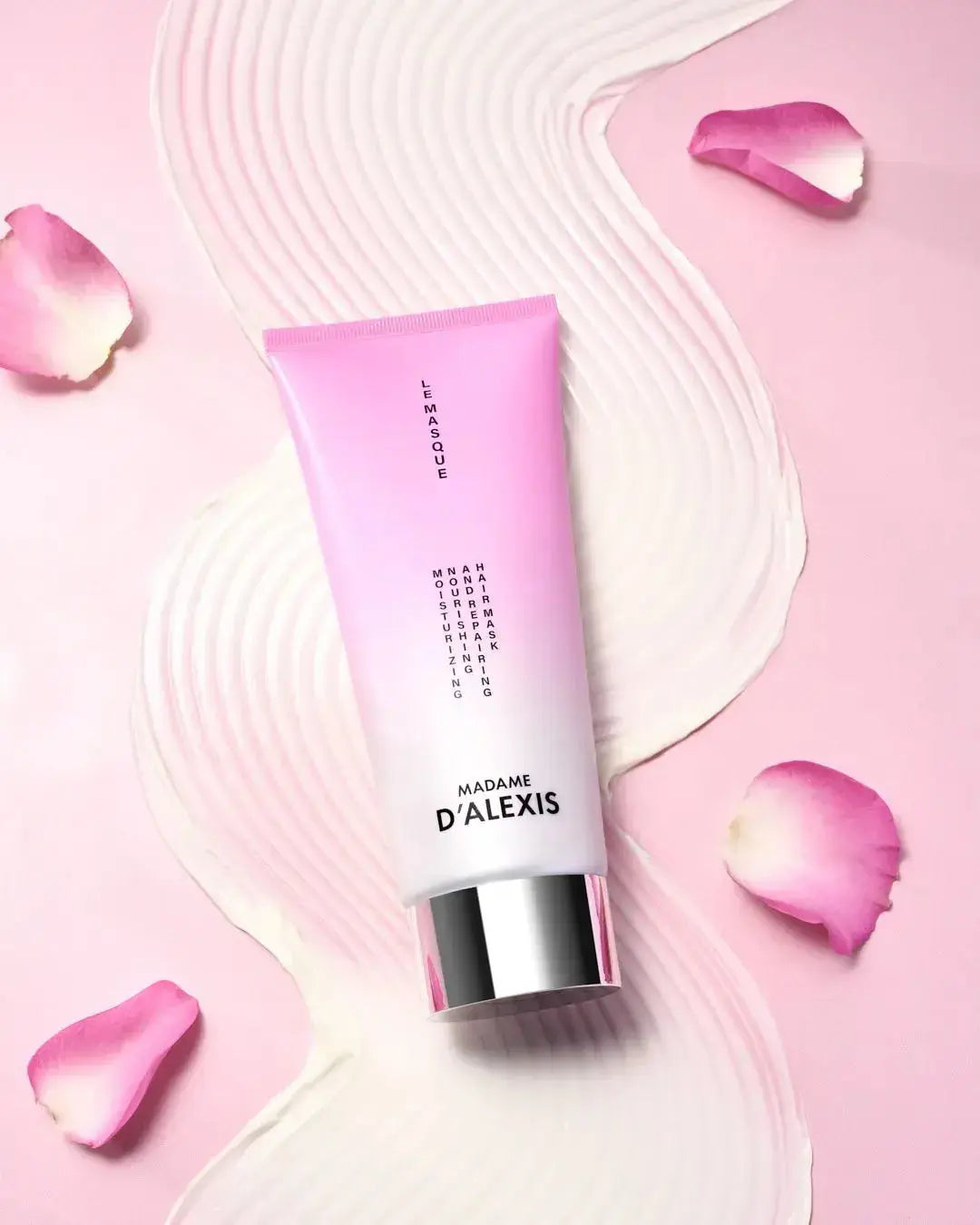
Le Masque aux Hydrolats Madame d'Alexis : le meilleur masque cheveux naturel
Pourquoi le Masque aux Hydrolats surclasse les alternatives
Le Masque aux Hydrolats n'est pas un simple masque avec des huiles capillaire. C'est une formule premium pensée comme un véritable soin réparateur du cheveu.
Les 7 piliers de sa supériorité
1. Formulated without added water
Là où un masque classique contient 60-90% d'eau inerte (qui dilue les actifs), le Masque aux Hydrolats remplace chaque goutte par des hydrolats bio actifs.
Résultat : Concentration active maximale et efficacité réelle dès la première utilisation.
2. Bioactive hydrosols: the key to effectiveness
La phase aqueuse du Masque aux Hydrolats est composée de trois hydrolats floraux bio :
- Damask rose hydrosol: rich in antioxidants, soothes irritation, restores natural radiance
- Chamomile Hydrosol: anti-inflammatory, reduces sensitivity, naturally brightens the skin
- Hydrolat de fleur d'oranger : tonifiant, stimule la régénération cellulaire, apporte de l'énergie aux cheveux
Ces hydrolats ne sont pas juste des parfums : ce sont des vecteurs bioactifs qui interagissent réellement avec la kératine et la structure du cheveu.
3. Actifs skincare appliqués au cheveu
Le Masque aux Hydrolats applique les standards du skincare premium aux cheveux :
- Cationic hyaluronic acid: deeply hydrates without drying out the skin, with an immediate plumping effect
- Kératine végétale : renforce la structure interne, améliore l'élasticité, réduit la casse de 40%
- Prebiotics: nourish the skin's flora and stabilize the scalp's microbiome
Ces ingrédients, habituellement réservés aux soins de la peau premium, transforment la fibre capillaire et rééquilibrent le cuir chevelu.
4. Texture adaptée à TOUS les types de cheveux
Contrairement aux masques "universels" qui ne conviennent à personne, le Masque aux Hydrolats est formulé pour être :
- Léger mais efficace : hydrate sans alourdir, même les cheveux fins
- Riche mais non-occlusif : nourrit les cheveux secs sans créer d'effet gras
- Apaisant et régulant : convient aux cuirs chevelus sensibles et gras
- Réparateur puissant : restaure les cheveux colorés et abîmés
5. Fabrication française en Bretagne
Chaque produit Madame d'Alexis est fabriqué avec le même niveau d'excellence que les soins skincare premium :
- Qualité des matières premières garantie
- Traçabilité complète
- Savoir-faire cosmétique français
- Textures maîtrisées, formules stables, efficacité garantie
6. Composition ultranaturelle, sans ingrédients controversés
- Sans sulfates : nettoyage doux, respectueux du cuir chevelu
- Sans silicones : brillance réelle, non artificielle
- Sans parabènes : composition clean, respectueuse du microbiome
- Sans microplastiques : respectueux de l'environnement
- 98% d'ingrédients d'origine naturelle : une transparence rare dans l'industrie cosmétique
7. Visible results from the very first uses
Ne pas formuler à base d'eau, c'est éviter la dilution des actifs et réduire les conservateurs. Chaque application du Masque aux Hydrolats agit vraiment :
- Sur le cuir chevelu : apaise, régénère, rééquilibre
- Sur la cuticule : lisse, apporte brillance
- Sur la fibre : hydrate, renforce, protège
Un effet visible dès la première utilisation, amplifié avec le temps.
Comparatif : Masque aux Hydrolats vs alternatives
| Criterion | Masque aux Hydrolats | Classic masks | Masques bio bon marché |
|---|---|---|---|
| No added water | ✓ YES | ✗ NO (60–90% water) | ✗ NO |
| Active Hydrosols | ✓ YES (3 hydrosols) | ✗ Synthetic fragrances | ✗ Peu ou pas |
| Hyaluronic acid | ✓ OUI (cationique) | ✗ Rarely | ✗ Rarely |
| Plant keratin | ✓ YES | ✗ Rarely | ✗ Rarely |
| Prebiotics | ✓ YES | ✗ NO | ✗ NO |
| Silicone-free | ✓ YES | ✗ NO | ✓ YES |
| Paraben-free | ✓ YES | ✗ NO | ✓ YES |
| Made in France | ✓ YES | ✗ Industrial production | ✗ Industrial production |
| Visible Results | ✓ Dès 1ère utilisation | ✗ 2–3 weeks | ✗ 3-4 semaines |
| Price | 53€ (200ml) | 30-80€ | $15–$30 |
| Customer Reviews | 4.78/5 (82 reviews) | 3.5–4.5/5 | 3,5-4/5 |
Verdict : Le Masque aux Hydrolats offre le meilleur rapport qualité-prix et efficacité réelle.
Mode d'emploi du Masque aux Hydrolats : protocole 30 jours
Semaine 1-2 : Phase de réparation intensive
Fréquence : 2x par semaine Durée : 10-15 minutes de pose Résultat : élimination des résidus, premiers signes de réparation
Étapes :
- Appliquez le Masque sur cheveux mouillés, du milieu jusqu'aux pointes
- Massez délicatement pour bien répartir
- Laissez poser 10-15 minutes (vous pouvez laisser plus longtemps)
- Rinse thoroughly with lukewarm water.
- Terminez par un jet d'eau froide pour refermer les écailles
Expected results:
- Cheveux plus brillants dès la 1ère utilisation
- Souplesse augmentée après 2-3 utilisations
- Cheveux moins cassants
Semaine 3-4 : Phase d'entretien et consolidation
Fréquence : 1x par semaine Durée : 10 minutes de pose Résultat : consolidation de la réparation, cheveux transformés
Étapes : identiques à la semaine 1-2
Expected results:
- Cheveux visiblement réparés et renforcés
- Restored Natural Luster
- Souplesse et élasticité augmentées
- Cuir chevelu rééquilibré
- Hair with more volume and a lighter feel
Après 30 jours : résultats visibles et durables
- ✓ Cheveux transformés : plus brillants, plus souples, plus volumineux
- ✓ Fibre capillaire renforcée : moins de casse, plus de résistance
- ✓ Cuir chevelu rééquilibré : moins irrité, moins gras ou sec
- ✓ Cheveux colorés : couleur préservée, brillance retrouvée
- ✓ Cheveux abîmés : réparation visible, texture lisse
- ✓ Cheveux bouclés : boucles définies, frizz réduit
Après 30 jours : routine d'entretien
Une fois que vos cheveux sont transformés, maintenez les résultats avec :
- 1x par semaine : Masque aux Hydrolats (entretien)
- Quotidien : Shampoing doux sans sulfates
- 2-3x par semaine : Sérum Nuit pour la régénération nocturne
Qu’est-ce qu’un masque cheveux naturel ?
Definition of a natural hair mask
A natural hair mask is a hair care product designed to act beyond the surface. It aims to improve the quality of the hair fiber by providing what it most often lacks: lipids, moisturizing agents, and protective active ingredients.
However, the word "natural" is a marketing term if it is not regulated. In France, the most useful reference to know is theISO 16128 standard, which proposes a method for calculating the percentage of ingredients of natural origin and helps to compare products more objectively.
My advice: look for brands that clearly explain their approach (percentages, choice of ingredients, exclusions).
To distinguish a genuine treatment from a simple "wow" effect, look for:
- a consistent list of ingredients (oils, butters, humectants, plant-based conditioning agents)
- a realistic promise (flexibility, repair, nutrition, protection)
- a tolerance designed for the scalp
Natural mask vs. conditioner
The two are often confused. However, their roles are not the same.
- Conditioner: detangles, smooths, improves texture, short application time (often 1 to 5 minutes).
- Mask: deeper treatment, longer application time (often 10 to 20 minutes), use 1 to 2 times a week.
Conditioner makes everyday life easier. Natural hair masks work on the hair itself, helping the fibers regain a more even texture, especially if your hair is dry, coarse, or brittle.
Why naturalness is sought after today
Three reasons keep coming up.
- Scalp sensitivity: itching, discomfort, reactions to products that are too harsh or too fragrant.
- Silicone saturation: many people appreciate the smoothing effect, but some formulas end up "coating" the hair to such an extent that they prevent the proper absorption of treatments and dull the hair fiber.
- The search for long-lasting care: we no longer want results that disappear with the next wash. We want visible, measurable improvement that lasts.
My position is simple: a natural hair mask is valuable primarily for its formulation and regular use. The rest is just noise.

5 erreurs courantes avec un masque cheveux
Erreur 1 : Appliquer le masque sur les racines
Beaucoup appliquent le masque sur tout le cheveu, y compris les racines. C'est une erreur.
Les racines produisent naturellement du sébum. Un masque sur les racines les alourdit et les rend grasses.
✓ Solution : Appliquez le masque du milieu jusqu'aux pointes. Laissez les 5-10 premiers centimètres près des racines sans masque.
Erreur 2 : Laisser poser trop longtemps
Certains pensent que laisser poser 30-60 minutes donne de meilleurs résultats. C'est faux.
Au-delà de 15-20 minutes, les actifs du masque ne pénètrent plus. Vous gaspillez juste du produit.
✓ Solution : Laissez poser 10-15 minutes maximum. C'est le temps optimal pour que les actifs agissent.
Erreur 3 : Ne pas rincer suffisamment
Un rinçage incomplet laisse des résidus qui ternissent les cheveux et les rendent gras.
✓ Solution : Rincez très abondamment à l'eau tiède, puis terminez par un jet froid pour refermer les écailles.
Erreur 4 : Utiliser un masque trop riche sur cheveux fins
Si vos cheveux sont fins ou plats, un masque trop riche les alourdit et les rend mous.
✓ Solution : Choisissez un masque léger mais efficace. Le Masque aux Hydrolats est formulé pour être léger tout en étant très hydratant.
Erreur 5 : Attendre des résultats immédiats
Après avoir utilisé des produits agressifs pendant des années, vos cheveux ont besoin de temps pour se régénérer.
✓ Solution : Soyez patient. Les résultats arrivent progressivement. Donnez-vous 2-3 semaines avant de juger.

The benefits of a natural hair mask tailored to your needs
A well-formulated natural hair mask doesn't just improve the appearance of your hair. It works on what really matters: the balance between hydration, protective lipids, and scalp comfort.
My vision is simple: you get better results when you choose a mask for a specific need and stick with it over time, rather than randomly switching between ten different products.
Natural hair mask for dry hair
Dry hair often lacks protective lipids. As a result, the hair fiber snags, dehydrates more quickly, and becomes coarse and brittle. An effective natural hair mask must combine two key ingredients.
- Hydration: it provides humectants that attract and retain water in the fiber.
- Nutrition: vegetable oils and butters help limit water loss by forming a flexible protective layer.
- Flexibility: over a few weeks, hair becomes more manageable, softer to the touch, and shinier without looking greasy.
My advice: apply to lengths and ends on towel-dried hair and leave on long enough for the treatment to work.
Natural hair mask for damaged or colored hair
Décoloration, coloration, chaleur, brossage énergique : tout cela fragilise les écailles du cheveu. Ici, le bon masque n’est pas seulement “riche”, il doit être réparateur et protecteur.
- Repair: look for active ingredients that can support fiber cohesion, such as plant-based ceramides, known to contribute to lipid "cement."
- Fiber protection: a well-designed mask reduces porosity, limits breakage, and improves detangling.
- Color preservation: smoothing the cuticle helps the color stay brighter, wash after wash.
My rule: if your hair is very sensitive, it is better to apply the mask regularly, even for shorter periods, rather than using a treatment occasionally.
Natural hair mask for oily hair
Oily hair does not mean you have to avoid using a hair mask. Often, the lengths are dry while the roots quickly become oily again. The classic mistake is to apply the mask all over.
- Regulation: avoid applying to the scalp if your hair is prone to oiliness.
- Lightness: choose a texture that rinses off easily and does not weigh down the hair.
- Scalp care: for the root area, I prefer targeted treatments (gentle cleanser, thorough rinsing, gradually spacing out washes) rather than a nourishing mask.
Natural hair mask for sensitive scalps
A sensitive scalp reacts quickly: itching, tightness, discomfort. Here, tolerance is key.
- Soothing: choose simple formulas without excessive fragrance and with ingredients known for their gentleness.
- Itching: a product that is too occlusive or poorly rinsed can aggravate discomfort; the way you apply it is just as important as the formula itself.
- Respect for the microbiome: the microbial balance of the scalp is linked to comfort. When it becomes unbalanced, irritation and dandruff can appear.
My opinion: a natural hair mask can help, but only if it is gentle on the scalp and part of a consistent routine.
The key ingredients for an effective natural hair mask
A high-performance natural hair mask is based on a simple but demanding principle: each ingredient must have a specific and measurable function.
It is not a question of stacking up "natural" ingredients to reassure consumers, but rather of developing a coherent formula capable of acting on the hair fiber and, indirectly, on the scalp.
This is where the difference between a pleasant treatment and a truly beneficial treatment lies.
Vegetable oils
Vegetable oils are at the heart of many natural hair masks. Their main role is to nourish the hair fiber and limit dehydration.
- Coconut oil: valued for its ability to soften dry lengths and improve texture. It is particularly suitable for thick or very dry hair.
- Jojoba oil: often chosen for its affinity with hair. Its lighter texture limits the greasy effect and is more suitable for fine hair.
- Argan oil: known for its softening and shine-enhancing properties, it is ideal for damaged or colored hair.
- Avocado oil: richer, it is useful when the fiber is coarse and lacks lipid protection.
My point of view is clear: a well-chosen oil in the right dosage is more effective than several poorly balanced oils.
Organic hydrosols
Organic hydrosols are a real differentiating factor. Unlike water, which is often used as a simple carrier, a hydrosol adds a functional dimension to the aqueous phase.
- Role in relation to water: hydrosol is not neutral. It contributes to the overall action of the treatment.
- Penetration: its light texture facilitates even distribution of the mask over the fiber.
- pH: naturally slightly acidic, it helps smooth the cuticle.
- Shine: a better aligned cuticle reflects more light.
In my opinion, this is one of the smartest choices for formulating a modern and effective natural hair mask.
Natural butters
Vegetable butters enhance the nourishing action of the mask.
- Beurre de karité : il apporte confort, souplesse et protection, particulièrement utile sur cheveux secs et cassants.
- Cocoa butter: denser, it coats the hair fiber more effectively and is suitable for thick or very damaged hair.
They must remain under control to avoid becoming burdensome.
Functional natural ingredients
Certain active ingredients complement the formula without overloading it.
- Aloe vera: moisturizes and provides comfort.
- Honey: known for its moisturizing properties, it helps maintain hydration.
- Proteins: useful for temporarily strengthening weakened fibers.
- Acids: they adjust the pH and improve the feel.

Homemade natural hair mask or formulated product?
Benefits of homemade natural hair masks
Le masque maison séduit par sa simplicité.
- Accessibility of ingredients
- Customization based on hair condition
- Occasional use for immediate needs
Limits of DIY hair care
In practice, DIY quickly reveals its weaknesses.
- Random dosage, often too high or ineffective
- Limited stability of mixtures
- Delicate preservation
- Uneven results from one application to another
Why a formulated mask is more effective than a DIY homemade mask
A specially formulated mask provides optimized bioavailability, controlled synergy of active ingredients, and reproducible results. For visible and lasting improvement, this choice is usually what makes the difference.
How to use a natural hair mask?
A natural hair mask delivers real results when used correctly. Too often, people apply high-quality products without following the essential steps.
Result: partially effective, if at all. Based on my experience, here is the best way to incorporate it into a consistent hair care routine.
Hair preparation
It all starts even before the mask is applied.
- Shampoo: hair must be clean. Shampoo removes sebum and styling product residue and slightly opens the cuticle, which facilitates the action of the mask.
- Rubbing: Hair saturated with water dilutes the treatment. Gently squeeze out excess water by hand or with a towel.
- Distribution: Detangle slightly to ensure even application, especially on long or thick hair.
This preparation time directly affects the effectiveness of the natural hair mask.
Application
The most common mistake isto apply the mask indiscriminately.
- Roots vs. lengths: unless specifically indicated, the mask should be applied to the lengths and ends. The roots generally do not need it.
- Quantity: no need to overload. A small amount per section is sufficient if the product is well formulated.
- Application: smooth the product onto each strand, then massage gently into the lengths to aid penetration.
My opinion is clear: precise application is better than a mask applied "at random."
Leave-in time
The application time makes all the difference between a cosmetic treatment and an active treatment.
- Minimum: below 5 minutes, the action remains superficial.
- Optimal: between 10 and 20 minutes depending on the condition of the hair.
- Common mistakes: leaving it on for too long does not necessarily improve the result and can weigh down the hair, especially on fine hair.
The natural hair mask works by gradual affinity, not excess.
Rinsing and frequency
- Warm water: this removes excess product without damaging the hair fiber.
- Frequency: Once or twice a week is sufficient for most hair types. Any more than that and your hair may lose its lightness.
Consistency is more important than excessive frequency.
Our natural hair mask Madame d'Alexis
Our Madame d'Alexis natural hair mask has been designed as a complete treatment, inspired by skincare standards applied to hair.
Its formula contains no added water and is based on organic hydrosols, combined with active ingredients carefully selected for their proven effectiveness.
Key benefits
- Deep hydration without weighing down the skin
- More flexible and visibly reinforced fiber
- Natural shine and silky feel
- Scalp comfort respected
Differentiating ingredients
- Organic hydrosol base instead of water
- Natural nourishing and repairing active ingredients
- Balance between nutrition, lightness, and tolerance
For what hair types
FAQ: Your questions about natural hair masks
What is the best natural hair mask?
There is no single "best" universal natural hair mask. The right mask is one that suits the actual condition of your hair and your needs. A very rich mask will suit dry or thick hair, but will not be suitable for fine hair. In my opinion, the most reliable criterion is still the formulation: a high-quality base, useful active ingredients, realistic claims, and good long-term tolerance.
Natural mask or organic mask: what's the difference?
A natural hair mask refers to the origin of the ingredients. An organic mask goes further by incorporating a certification process, with strict rules on raw materials and their processing. In practice, an organic mask is always natural, but a natural mask is not always organic. What really matters, beyond the label, is the overall consistency of the formula and its effectiveness on the hair fiber.
Can you use a natural hair mask every week?
Yes, in most cases. A natural hair mask can be applied once or twice a week without any problems, provided it is well formulated and thoroughly rinsed out. However, using it too often can weigh down fine hair or reduce volume. The right frequency is determined by how your hair feels and looks, not by a fixed rule.
Is natural hair mask suitable for curly hair?
Curly hair often benefits greatly from a natural hair mask. Its spiral structure makes it more difficult for sebum to circulate, which explains its tendency to dry out. A suitable mask helps to:
- improve flexibility
- strengthen the definition
- reduce frizz
However, I recommend nourishing but well-balanced textures to avoid the "limp curl" effect.
Can you apply a natural mask to the scalp?
It depends on the mask. Most natural hair masks are designed for the lengths and ends of the hair. Applying them to the scalp can weigh the hair down or cause it to become greasy. However, certain specific masks that are lighter and formulated for the scalp can be used at the roots. It is essential to follow the product instructions.
Natural hair masks and oily hair: compatible or not
Yes, provided you use it correctly. On oily hair, the mask should only be applied to the lengths. It helps to rebalance dry areas without stimulating sebum production at the roots. It is often a mistake to completely avoid using masks when you have oily hair.
Natural hair mask during pregnancy or breastfeeding
In general, a well-formulated natural hair mask is compatible with pregnancy and breastfeeding. However, it is recommended to avoid formulas containing essential oils or overly concentrated fragrances. Caution should be exercised by carefully reading the ingredients and choosing products designed for sensitive scalps.
How long should you leave a natural hair mask on?
The optimal application time is generally between 10 and 20 minutes. Any less than that and the effect will be limited. Any longer than that and the results will not necessarily be better. Contrary to popular belief, leaving the mask on "as long as possible" does not always bring greater benefits. However, with the Madame d'Alexis mask, you can leave it on overnight for a volumizing effect.
Can a natural hair mask replace conditioner?
No, they don't have the same function. Conditioner makes it easier to detangle hair and improves its feel on a daily basis. Natural hair masks provide deeper care and are used less often. The two are complementary in a well-thought-out routine.
How to make a homemade hair mask?
Making a homemade hair mask involves simple steps and common ingredients. The goal is not to use lots of different ingredients, but to create a consistent hair mask that is easy to apply and pleasant to rinse out. A good mask recipe always starts with beneficial ingredients that are suited to the condition of your hair.
Classic basics to know:
- 1 to 2 tablespoons ofolive oil orcoconut oil for nutrition
- 1 egg yolk for protein
- 1 tablespoon of honey or plain yogurt for hydration
- Optional: 1 tablespoon of aloe vera gel for suppleness
Simply mix thoroughly until you obtain a smooth texture. These natural hair care recipes are suitable for occasional use, particularly on dry or dull hair.
What ingredients are needed for a natural face mask?
The ingredients in a natural mask must meet a specific need. Each family has a function.
- Vegetable oils: castor oil, avocado oil, nourishing oils for the hair fiber
- Butter: shea butter, protective and softening
- Fruits: banana, avocado, rich and nourishing
- Dairy products: honey, plain yogurt, useful for hydration
- Additional ingredients: apple cider vinegar for shine, clay powder to purify, lemon juice to tighten the cuticle
- Essential oil: use with caution and sparingly
The right approach is to keep it simple. Too many ingredients often reduce effectiveness.
What are the benefits of hair masks?
A mask is first and foremost a deep hair treatment. When chosen correctly, it can:
- Nourish and moisturize the fiber
- Repair damaged hair
- Provide protection and reinforce the structure
- Makes hair soft, supple, and shiny
- Enhanceradiance and shine
- Act on dry and damaged hair
- Supporting an environment conducive to growth
The effects are gradual. A mask works deep down, not in a single step.
How do I choose a hair mask?
The choice always depends on hair type and hair care routine.
- Normal hair: balancing, lightweight mask
- Dry curly hair: nourishing and moisturizing mask
- Oily hair: mask for oily hair, applied only to the lengths
- Damaged hair: repairing mask
- Dehydrated hair: moisturizing mask
- Organic hair mask: beneficial for sensitive scalps
A product tailored to your needs always gives better results than a universal mask.
How long should a mask be left on?
The exposure time determines the effectiveness:
- Leave on for at least 5 minutes
- Ideally, leave on for 10 to 20 minutes.
- Adjust the duration to the condition of the hair
Proper application followed by thorough rinsing is better than excessive application time.
How can I get an effective mask?
An effective mask depends on the method.
- Obtain a smooth paste
- Mix well until smooth.
- Choose an ideal recipe that is simple and targeted
- Follow the preparation,use, and rinsing instructions.
Whether it's a natural mask or a homemade mask, the consistency of the ingredients and regularity make all the difference.
Combien de temps avant de voir les résultats avec le Masque aux Hydrolats ?
Vous verrez les premiers résultats dès la première utilisation : cheveux plus brillants, plus souples. Les résultats s'amplifient avec le temps :
- Semaine 1-2 : brillance et souplesse visibles
- Semaine 3-4 : réparation visible, cheveux transformés
- Après 30 jours : transformation complète, cheveux renforcés et régénérés
Le Masque aux Hydrolats convient-il à tous les types de cheveux ?
Oui. Grâce à sa formule légère mais efficace et ses actifs hydratants, le Masque aux Hydrolats convient à tous les types de cheveux :
- Cheveux fins : hydrate sans alourdir
- Cheveux épais/bouclés : nourrit et définit les boucles
- Cheveux secs/abîmés : répare en profondeur
- Cheveux gras : régule sans assécher
- Sensitive hair: soothes irritation
- Cheveux colorés : préserve la couleur, restaure la brillance
Puis-je utiliser le Masque aux Hydrolats si j'ai un cuir chevelu très sensible ou irrité ?
Oui, c'est même recommandé. Le Masque aux Hydrolats est particulièrement adapté aux cuirs chevelus sensibles grâce à :
- Ses hydrolats apaisants (camomille, rose)
- Ses propriétés anti-inflammatoires naturelles
- L'absence de sulfates, parabènes, silicones
- Ses prébiotiques qui rééquilibrent le microbiome
Appliquez le masque du milieu jusqu'aux pointes, en évitant les racines si votre cuir chevelu est très irrité.

