Advice
Scalp Scrub: The Complete Guide to Exfoliating and Purifying
Scalp Scrub: Discover the benefits, DIY recipes, and scrubs for oily and sensitive scalps. Effective natural ingredients and the best organic products.

Homemade Scalp Scrub: Natural Recipes, Benefits, and the Best Care
A scalp scrub removes dead skin cells, excess sebum, and impurities that have built up on the scalp. The result: a healthy scalp, healthy hair, and better absorption of your hair care products.
What you will find in this article:
- The Proven Benefits of Scalp Exfoliation
- 5 DIY Recipes: Sea Salt, Sugar, Coffee Grounds, Clay, Aloe Vera
- The Best Natural Ingredients for an Effective Scrub
- How to Soothe a Sensitive Scalp with a Gentle Scrub
- A Comparison of the Best Organic Exfoliators Available in France
- Complete instructions for use: frequency, application, rinsing
Recommended product: The Scalp Exfoliating Scrub —a purifying cleansing scrub made with organic hydrosols, sea salt, and fleur de sel. 98% naturally derived, sulfate-free.
A clean scalp, without a complicated routine
Homemade recipes are a lifesaver. Madame d'Alexis's Exfoliating Scrub takes it a step further: it exfoliates, cleanses, and delivers skincare ingredients all in one step, for a simpler, cleaner, and more premium experience.
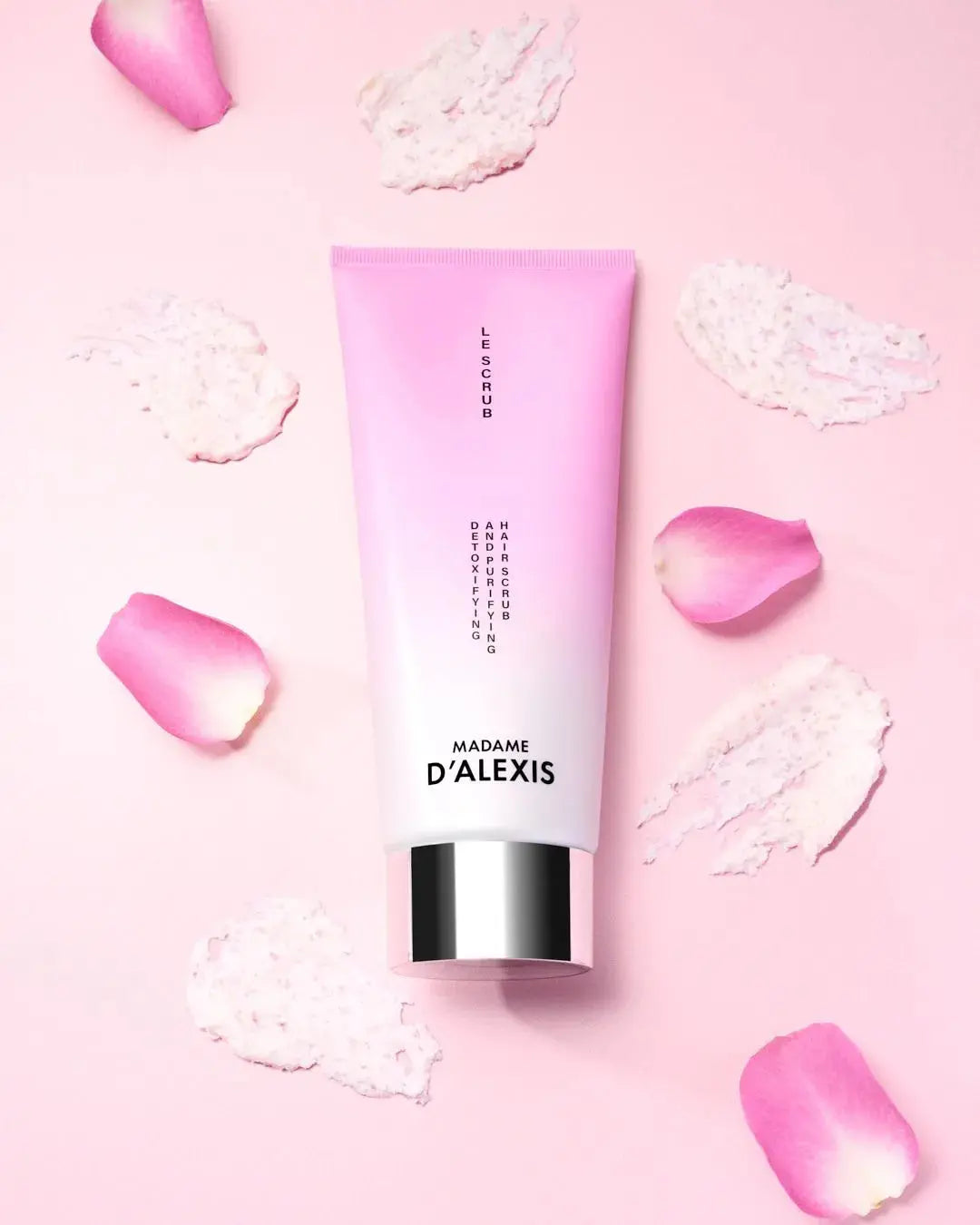
Madame d'Alexis Exfoliating Scrub
Scrub + Shampoo in One · 98% Natural
- Fleur de sel and organic active hydrosols
- Cleanses the scalp without sulfates
- Helps remove sebum, residue, and dead skin cells
What Is a Scalp Scrub? Benefits and How It Differs from a Body Scrub
Scalp exfoliation is a hair care trend that has become an essential step in any serious hair care routine. Long reserved for the face and body,scalp exfoliation is now recognized as a key step for healthy hair.
Here are the 6 main, documented, and tangible benefits.
It removes impurities and dead skin cells
Every week, your scalp accumulates residue from shampoo, serum, hair masks, gel, pollution, and hard water. These impurities form a layer that clogs the hair follicles and disrupts the scalp’s natural microbiome.
A hair scrub works mechanically thanks to its exfoliating particles—such as sea salt, sugar, peach pit powder, and clay—to gently remove these residues without irritating the skin.
Immediate results: a clean scalp, lighter hair, and a long-lasting feeling of freshness.
It stimulates hair growth
The massage performed while applying the scrub stimulates blood circulation at the roots. Better circulation = more nutrients delivered to the follicles = hair that grows faster and stronger.
It's one of the simplest and most effective ways to promote natural hair growth without a complicated regimen.
Results after 4–6 weeks: visible hair growth, thicker roots.
It restores balance to sebum production
Excess sebum is often the result of a clogged scalp trying to compensate. By deeply cleansing the scalp, this exfoliating scrub helps regulate sebum production over the long term.
Results after 2–3 weeks: Hair becomes oily less quickly, and the scalp is balanced.
It reduces dandruff and itching
Dandruff is often caused by a buildup of residue and inflammation of the scalp. Regular exfoliation reduces this inflammation and removes visible flakes.
Results after 1–2 weeks: less dandruff, less itching.
It prepares the scalp to absorb the treatment
A clogged scalp prevents your hair care products from being absorbed. After exfoliating, your hair masks, serums, and creams penetrate the hair shaft 2 to 3 times more effectively.
Immediate result: improved effectiveness of all your hair care products.
It adds volume and shine
With no residue, hair feels lighter, has more volume, and has a natural shine. This is one of the most noticeable benefits right from the first use.

Why does the scalp feel stuffy, and what are the signs of an unhealthy scalp?
How to Make a Homemade Scalp Scrub (Natural Recipe)
Making your own body scrub is a simple, economical, and customizable idea. These recipes use natural ingredients that are easy to find in stores or online.
Tip: Homemade recipes are a great place to start. For maximum effectiveness and a stable formula, a professional cosmetic product like the Exfoliating Scrub is still the best option.
Homemade Sugar and Shampoo Scalp Scrub Recipe
The simplest and most effective recipe for a homemade scalp scrub: mix 2 tablespoons of brown sugar with a small amount of mild shampoo. Apply to a damp scalp, massage in circular motions for 3 minutes, then rinse thoroughly.
Brown sugar mechanically exfoliates dead skin cells and product residue. The shampoo emulsifies oils. The result: a refreshed scalp in 5 minutes, with no extra effort.
Use no more than once every two weeks—sugar can be abrasive on a sensitive scalp.
Baking Soda Scalp Scrub Recipe
Mix 1 teaspoon of baking soda with your regular shampoo. Apply to a wet scalp, massage for 2 minutes, and rinse thoroughly.
Warning: Baking soda has a high pH, around 8.3, which can disrupt the scalp’s hydrolipidic film, whose natural pH is around 4.5–5.5. Use it only occasionally—no more than once a month—and always follow up with a moisturizing treatment or a cider vinegar rinse to restore the pH balance.
Recipe 1: Sea Salt + Coconut Oil (Basic Recipe)
Ingredients:
- 2 tablespoons of fine sea salt
- 1 tablespoon of virgin coconut oil
- 3 drops of lavender essential oil
Preparation: Mix the sea salt and coconut oil in a small bowl. Add the essential oil and mix again.
Directions: Apply to hair that has been dampened with lukewarm water, focusing only on the scalp. Massage in circular motions for 2 to 3 minutes. Rinse thoroughly.
Suitable for: all hair types.
Frequency: Once a month.
Recipe 2: Sugar + Vegetable Oil (Gentle Scrub)
Ingredients:
- 2 tablespoons of white or brown sugar
- 1 tablespoon of vegetable oil: jojoba or sweet almond
- 2 drops of peppermint essential oil
Preparation: Mix all the ingredients in a bowl until the mixture is smooth.
Usage: Same as Recipe 1.
Suitable for: sensitive scalps, dry hair.
Frequency: 1 to 2 times a month.
Recipe 3: Coffee grounds + coconut oil (purifying scrub)
Ingredients:
- 2 tablespoons of coffee grounds, fresh or dried
- 1 tablespoon of coconut oil
- 2 drops of tea tree essential oil
Preparation: Save the coffee grounds after making your coffee. Let them dry slightly. Mix them with the oil and essential oil.
Suitable for: oily scalp, oily hair.
Frequency: Once a month.
Recipe 4: Clay + Aloe Vera (Soothing Scrub)
Ingredients:
- 2 tablespoons of green or white clay
- 1 tablespoon of pure aloe vera gel
- 1 tablespoon of lukewarm water
- 2 drops of lavender essential oil
Preparation: Mix the clay with the aloe vera and lukewarm water until you have a smooth paste. Add the essential oil.
Suitable for: irritated, itchy scalps.
Frequency: Once a month.
Recipe 5: Baking Soda + Coconut Oil (Effective Scrub)
Ingredients:
- 2 tablespoons of baking soda
- 1 tablespoon of coconut oil
- 1 tablespoon of lukewarm water
- 2 drops of peppermint essential oil
Preparation: Mix all the ingredients together. Suitable for: oily scalps. Frequency: Once a month at most.
Warning: Baking soda can be harsh on sensitive skin. Do not use more than once a month.
How do you use an exfoliating scalp shampoo?
How to Exfoliate Your Scalp Properly (Tutorial)
Comparison Chart: Which Recipe Should You Choose?
| Recipe | Hair type | Effectiveness | Sweetness | Cost |
|---|---|---|---|---|
| Sea salt + coconut oil | All | ⭐⭐⭐⭐ | ⭐⭐⭐ | Very low |
| Sugar + vegetable oil | Sensitive, dry | ⭐⭐⭐ | ⭐⭐⭐⭐⭐ | Very low |
| Coffee grounds + oil | Fat | ⭐⭐⭐⭐⭐ | ⭐⭐⭐ | Free |
| Clay + aloe vera | Sensitive, irritated | ⭐⭐⭐⭐ | ⭐⭐⭐⭐⭐ | Bottom |
| Baking Soda + Oil | Fat | ⭐⭐⭐⭐⭐ | ⭐⭐ | Very low |

Homemade Scalp Scrub for Oily Hair
An oily scalp is one of the most common hair conditions. It is characterized by excess sebum, hair that looks flat the day after washing, and sometimes itching or an unpleasant odor.
A purifying exfoliating scrub is the most effective way to regulate sebum production over the long term.
Key Ingredients for an Oily Scalp
- Sea salt: purifying, mineralizing, regulates sebum production, and stimulates blood circulation.
- Peppermint: regulates sebum production, refreshing, stimulating. Use as a diluted essential oil.
- Activated charcoal: absorbs excess oil and impurities. Ideal for oily skin.
- Green clay: purifying, absorbent, and balancing. One of the best clays for an oily scalp.
- Tea tree: a natural antifungal and antibacterial agent. Helps restore balance to the scalp's microbiome.
Best Recipe for an Oily Scalp
Ingredients:
- 2 tablespoons of fine sea salt
- 1 tablespoon of jojoba oil, which is light and non-comedogenic
- 3 drops of peppermint essential oil
- 2 drops of tea tree essential oil
- 1 pinch of activated charcoal (optional)
Frequency: Twice a month.
Expected result: less oily hair in 2 to 3 weeks.
Recommended product for oily scalps
The Exfoliating Scrub is formulated with sea salt and organic hydrosols. Its purifying cleansing scrub texture deeply cleanses without irritating sensitive skin. Available in our natural hair care collection.
Scalp Scrub for Curly Hair
Curly hair tends to accumulate more residue from styling products—such as gels, creams, and mousses. An exfoliating scrub once a month is essential in any CGM routine to remove this residue before applying moisturizers.
Apply the scrub only to the scalp—never to the lengths of your hair—and then follow with a moisturizing treatment to preserve the definition of your curls.
What Is the Best Scalp Scrub? Selection Criteria
The quality of a hair scrub depends directly on its ingredients. Here are the most effective natural ingredients, along with their characteristics and uses.
Natural vs. Conventional Scalp Exfoliation
A natural scrub uses plant- or mineral-based exfoliating particles, such as fine salt, sugar, clay, or natural powders. A conventional scrub may be effective, but it sometimes contains sulfates, silicones, or synthetic fragrances that provide an immediate cleansing effect without respecting the microbiome.
The best scalp scrub, then, is one that cleanses without stripping the scalp, rinses off easily, is gentle on the scalp, and truly prepares it for subsequent treatments.
Exfoliating particles
- Sea salt: the go-to ingredient. Gently exfoliates, replenishes minerals, and stimulates circulation. Available in fine or medium grain sizes.
- Sugar: gentler than salt, ideal for sensitive skin. Slightly moisturizing thanks to its hygroscopic properties.
- Coffee grounds: a free, eco-friendly natural exfoliant. Stimulates blood circulation and effectively cleanses the skin.
- Peach pit powder: a very gentle, natural plant-based exfoliant. Ideal for sensitive skin that cannot tolerate salt.
- Clay: purifying and absorbent. Green clay is suitable for oily scalps, while white clay is suitable for sensitive scalps.
Functional Assets
- Vegetable oil: moisturizes and nourishes the scalp during exfoliation. Jojoba for oily scalps, coconut or sweet almond for dry scalps.
- Plant extracts: chamomile, calendula, and stinging nettle. These extracts soothe, strengthen, and protect the scalp based on their specific properties.
- Aloe vera: soothing, moisturizing, anti-inflammatory. Perfect for irritated or sensitive scalps.
- Glycolic acid: a naturally derived cosmetic ingredient that provides gentle chemical exfoliation. Complements the mechanical action of the particles. Use with caution on sensitive scalps.
- Organic hydrosols: floral waters obtained through steam distillation. Rose, chamomile, orange blossom. They soothe, moisturize, and naturally scent the skincare product. This is what makes the Exfoliating Scrub unique: a base formulated with certified organic hydrosols—an original idea and a guaranteed natural origin.
Table: Ingredients by Hair Type
| Hair type | Recommended Ingredients | To be avoided |
|---|---|---|
| Fat | Sea salt, mint, charcoal, tea tree, green clay | High-fat oils, sugar alone |
| Sensitive | Sugar, aloe vera, white clay, peach pit powder | Coarse salt, baking soda |
| Dry | Sugar, coconut oil, aloe vera, plant extracts | Green clay, charcoal |
| Normal | Sea salt, sugar, clay, vegetable oil | No harsh ingredients |
| With film | Clay, tea tree, aloe vera, charcoal | Harsh ingredients |
How can you soothe a sensitive scalp?
A sensitive scalp reacts easily to external irritants: chemicals, pollution, hard water, and friction. Symptoms include itching, redness, dandruff, or a feeling of discomfort.
Contrary to popular belief, a gentle exfoliation can help soothe a sensitive scalp—as long as you choose the right moisturizing ingredients and adjust how often you use it.
Ingredients to prioritize
- Sugar: a very gentle natural exfoliant that is well tolerated by sensitive skin.
- Aloe vera: soothes, moisturizes, and reduces inflammation. One of the best moisturizing ingredients for sensitive scalps.
- Coconut oil: nourishing, anti-inflammatory, soothing. Ideal for dry and sensitive skin.
- White clay: gentle, mineral-rich, soothing. Much better tolerated than green clay on sensitive skin.
- Chamomile or rose hydrosols: soothing, calming, and anti-redness. They provide the ideal base for a purifying cleansing scrub for sensitive scalps.
- Lavender essential oil: soothing, healing, and well-tolerated by sensitive skin.
Ingredients to avoid
- Coarse-grained salt, too harsh
- Baking soda can disrupt the pH balance
- Pure, undiluted tea tree oil—too concentrated
- Sulfates, SLS, SLES: Check the ingredients in your products
- Synthetic fragrances, which can irritate sensitive skin
Gentle Scalp Scrub Recipe for Sensitive Scalps
Ingredients:
- 2 tablespoons of fine white sugar
- 1 tablespoon of pure aloe vera gel
- 1 tablespoon of coconut oil
- 1 tablespoon of chamomile hydrosol
- 2 drops of lavender essential oil
Preparation: Mix all the ingredients in a small bowl until the mixture is smooth.
Directions: Apply to hair dampened with lukewarm water. Massage very gently for 1 to 2 minutes at most. Rinse thoroughly. Follow with a homemade hair mask or Madame d'Alexis Soothing Hair Mask if needed.
Frequency: Once a month at most.
Complete Skincare Routine for Sensitive Scalps
Before: Test the product on a small area. Wait 24 hours beforeusing an exfoliating shampoo on your entire scalp.
During the procedure: use lukewarm water only, never hot. Use gentle, friction-free movements. Maximum duration: 2 minutes.
Afterward: Rinse with lukewarm water. Apply a moisturizing mask or a soothing serum. Leave it on for 10 minutes before rinsing.
Comparison of the Best Hair Scrubs
The market for organic and natural exfoliants has grown significantly in recent years. Here is a comparison of recommended products, ranked from the best to the most affordable.
| Product | Composition | Naturalness | Effectiveness | Price | Suitable for |
|---|---|---|---|---|---|
| Exfoliating Scrub (Madame d'Alexis) | Sea salt + organic hydrosols | 98% | ⭐⭐⭐⭐⭐ | 39 € | All types |
| Christophe Robin Sea Salt | Sea salt + oils | ~90% | ⭐⭐⭐⭐ | ~50€ | All types |
| Aroma-Zone Exfoliator | Sugar + essential oils | ~95% | ⭐⭐⭐ | ~25€ | Sensitive |
| Sephora Scalp Scrub | Salt + active ingredients | ~70% | ⭐⭐⭐ | ~30€ | All types |
| Yves Rocher Exfoliator | Salt + plant extracts | ~75% | ⭐⭐⭐ | ~35€ | All types |
Madame d'Alexis Exfoliating Scrub: Scrub + Shampoo in One
The downside of homemade remedies: they exfoliate mechanically but don't provide any active ingredients to the scalp.
Madame d'Alexis's Exfoliating Scrub combines two actions in a single step: gentle mechanical exfoliation with fleur de sel and natural exfoliating grains, plus skincare actives, prebiotics, postbiotics, and organic hydrosols of Damask rose and German chamomile. It detoxifies, purifies, and nourishes the microbiome all at once.
Sulfate-free, no added water, made in Brittany. Use it like a regular shampoo—1 to 2 times a month in place of your usual shampoo.
Exfoliating Scrub
Gentle exfoliation · purification · microbiome
- Exfoliating Sea Salt and Fleur de Sel
- Organic floral waters: rose, chamomile, orange blossom
- Sulfate-free, paraben-free, silicone-free
- 98% naturally derived ingredients
Best Organic Exfoliator: The Exfoliating Scrub
The Exfoliating Scrub is the only hair scrub in France formulated with organic hydrosols as its base. This is what fundamentally sets it apart from all other products on the market.
Ingredients:
- Exfoliating sea salt, fleur de sel
- Organic floral waters: rose, chamomile, orange blossom
- Sulfate-free, paraben-free, silicone-free
- Probiotics to restore balance to the scalp's microbiome
- 98% naturally derived ingredients
Benefits:
- Deep-Cleansing Exfoliator
- Soothes itching and redness
- Stimulates blood circulation and hair growth
- Prepares the scalp to absorb the treatment
- Suitable for colored, curly, normal, and oily hair
Best film scrub
For dandruff, opt for an organic scrub containing clay and tea tree oil. The exfoliating scrub, with its probiotics, is particularly effective at rebalancing the microbiome responsible for dandruff.
Best Exfoliating Scrub for Curly Hair
Curly hair tends to accumulate more residue from styling products—such as gels, creams, and mousses. An exfoliating scrub once a month is essential in any CGM routine to remove this residue before applying moisturizers.
Frequency and Technique: How to Properly Exfoliate Your Scalp
Step-by-Step Implementation Protocol
Step 1 - Preparation (1 min)
Wet your hair with lukewarm water. Squeeze a small amount of scrub into your palm. Spread it over your fingers.
Step 2 - Application (2 to 3 min)
Apply only to the scalp, never to the lengths of the hair. Start at the roots, working toward the temples and then the nape of the neck. Massage in gentle circular motions. Do not rub too hard.
Step 3 - Rinsing (2 to 3 min)
Rinse thoroughly with lukewarm water. Check to make sure there are no particles left. Rinse a second time to be sure.
Step 4 - Skincare (optional)
Use a mild shampoo if necessary. Then apply a hair mask or serum as part of your usual hair care routine.
Recommended frequency
| Scalp type | Frequency | Reason |
|---|---|---|
| Fat | twice a month | Need for regular cleaning |
| Normal | Once a month | Standard Maintenance |
| Sensitive | Once a month or less | Risk of irritation |
| Dry | Once a month or less | Risk of drying out |
| With film | 1 to 2 times a month | Depending on the severity |
Before or after shampooing?
Optimal order:
- Scalp scrub: 2 to 3 minutes
- Thorough rinsing
- Mild shampoo, optional
- Mask or serum, optional
- Final rinse
The scrub purifies first. The shampoo cleanses next. Skincare products are better absorbed after exfoliation.
7 Mistakes to Avoid
- Mistake 1 - Using it too often. More than twice a month = risk of irritation and disruption of the microbiome.
- Mistake 2 - Scrubbing too hard. Les mouvements doivent être doux et circulaires. Pas de friction agressive.
- Mistake 3 - Applying it to the lengths of the hair. The scrub is intended for the scalp only. When applied to the lengths, it dries out the hair and weakens the hair shaft.
- Mistake 4 - Not rinsing thoroughly. Particle residue left on the scalp can cause irritation. Rinse at least twice.
- Mistake 5 - Using hot water. Lukewarm water is a must. Hot water irritates and dries out the skin.
- Mistake 6 - Choosing a product that contains sulfates. Sulfates negate the benefits of exfoliation by irritating the scalp. Always check the ingredients.
- Mistake 7 - Not choosing a product suited to your hair type. Using a coarse-grained sea salt scrub on a sensitive scalp = guaranteed irritation. Choose a product suited to your hair condition.
FAQ
How often should you use a scalp scrub?
1 to 2 times a month, depending on your hair type. Oily scalp: 2 times a month. Normal or sensitive scalp: 1 time a month. Never exceed 2 times a month to avoid irritation.
Can a hair scrub dry out your hair?
No, not if you choose a natural exfoliant made with plant oils and hydrosols. A chemical exfoliant containing sulfates, on the other hand, can dry out your skin. Always check the ingredients.
Scalp Scrub vs. Clarifying Shampoo: What's the Difference?
The scrub works mechanically with exfoliating particles. The clarifying shampoo works chemically with chelating agents that remove limescale and mineral deposits. The two are complementary. Use them alternately: scrub in week 1, clarifying shampoo in week 3.
Can you use a scrub on colored hair?
Yes, but wait 48 hours after coloring your hair. Choose a gentle exfoliator—sugar or fine salt—and limit use to once a month to preserve the color.
Does exfoliation help prevent hair loss?
It helps indirectly. By clearing out hair follicles clogged with residue and stimulating blood circulation, exfoliation creates the best conditions for healthy hair growth. For direct action against hair loss, combine it with a nighttime hair regrowth serum.
Can you make a homemade scrub that's just as effective as a professional product?
DIY recipes are a good place to start. They let you make a simple exfoliator using readily available natural ingredients. However, they cannot replicate the stability, precise formulation, and advanced active ingredients—such as probiotics and certified organic hydrosols—found in a professional cosmetic product.
Is exfoliation compatible with the CGM routine for curly hair?
Yes, it's actually recommended. Curly hair tends to accumulate more styling product residue. Exfoliating once a month before your CGM routine helps remove this residue and maximizes the absorption of moisturizing products.
Useful sources
- Effects of Lauric Acid on Hair Fibers - PubMed
- Scalp Microbiome - Journal of Dermatological Science
- Organic Cosmetics Certification - Ecocert France
- Properties of Aloe Vera - INCI Beauty
SEO information to enter in Shopify:
- Title tag: Homemade Scalp Scrub: Recipes and the Best Care
- Meta description: Discover how to make a homemade scalp scrub, natural recipes using sugar and baking soda, tips for oily hair, and the best exfoliating treatment.
- After publication: Request that the URL be indexed in Google Search Console.