Advice
How do you use an exfoliating shampoo?
Scrub or exfoliating shampoo: What's the difference? Find out how to use an exfoliating shampoo based on your hair type for a purified and rebalanced scalp.

The exfoliating cleansing scrub isn't just a one-time monthly treatment. It's a cleansing product that replaces your shampoo when you use it, as part of a routine every 10 to 15 days, depending on your needs.
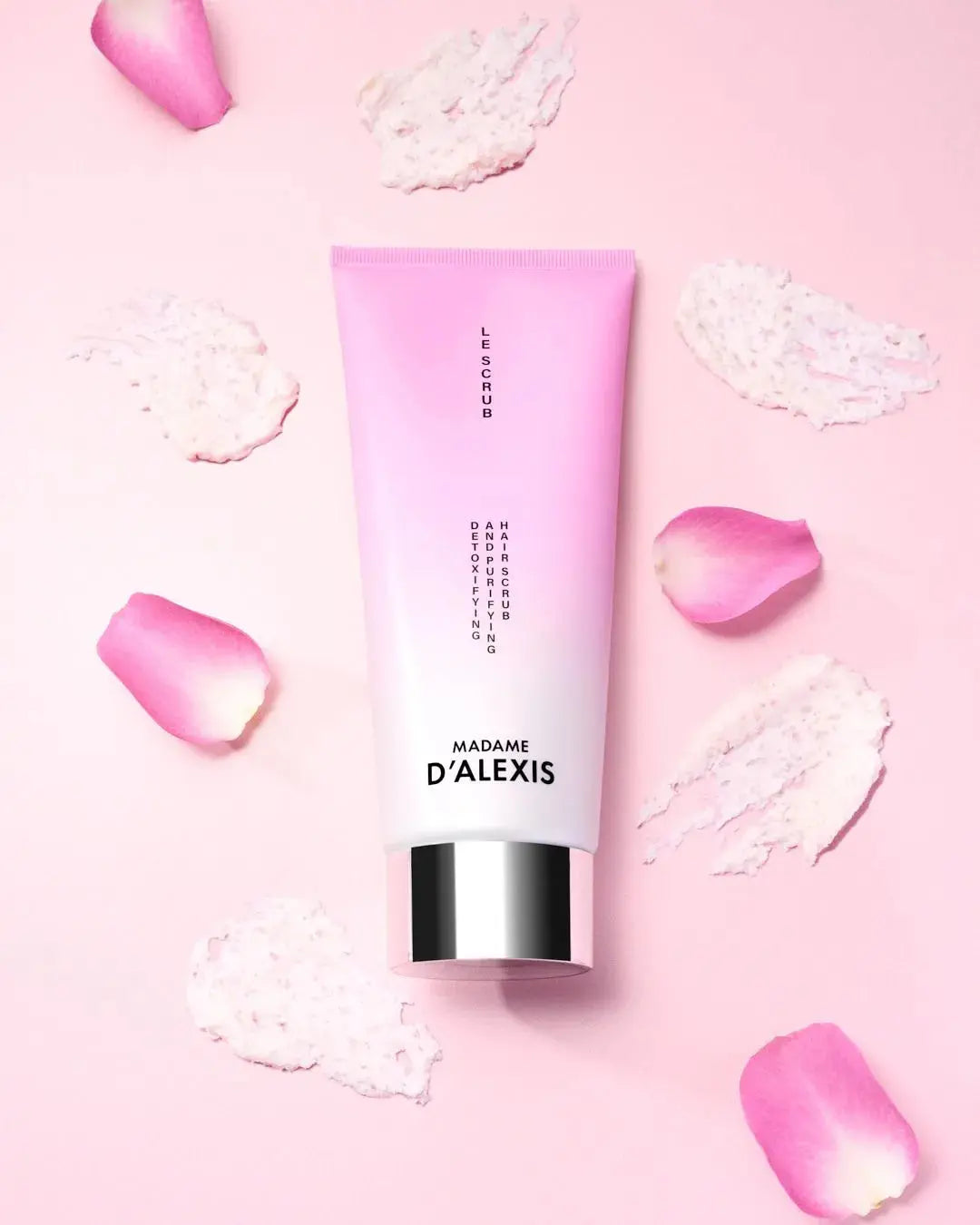
It deeply cleanses the scalp, removes impurities and dead skin cells, stimulates blood circulation, and moisturizes at the same time. Madame d'Alexis's scalp scrub is formulated without added water, using organic active hydrosols, fleur de sel, and cationic hyaluronic acid. Visible results appear gradually starting with the very first uses.
Have you heard of exfoliating shampoo but aren't sure exactly how to use it? Are you wondering if it's really any different from a regular scrub? Or are you worried it might be too harsh on your scalp?
This is a very common misunderstanding. The exfoliating cleansing scrub —also known as an exfoliating shampoo or hair scrub —is still often misunderstood. It is neither a daily shampoo nor a monthly deep cleanse. It is a cleansing treatment in its own right, designed to be incorporated into your hair care routine every 10 to 15 days.
This article explains in detail:
- The 6 Real Differences Between an Exfoliating Cleansing Scrub and a Traditional Scrub
- The Benefits of a Hair Scrub for the Scalp
- The correct application technique (wet and wrung out, circular motions, let it sit, rinse thoroughly)
- How to Adjust How Often You Use It Based on Your Hair Type
- How to Choose an Effective Exfoliating Shampoo for Oily Hair
- The Best Homemade Scrub Recipes and Their Real Limitations
- Why the Floral Scrub Is Better Than Homemade Solutions

Exfoliating Cleansing Scrub vs. Traditional Scrub: The 6 Key Differences
Many people use these two terms interchangeably. However, they are two very different products, with distinct uses, frequencies, and results.
1. Role in the routine: cleansing product vs. occasional treatment
- Classic exfoliation: an occasional addition. It is done IN ADDITION to your usual routine, once or twice a month at most.
- Exfoliating cleansing scrub: It replaces your shampoo when you use it. Incorporate it into your hair care routine every 10 to 15 days, depending on your needs—not every day, not every week.
- Result: The exfoliating cleansing scrub provides a complete scalp reset with every use. The scrub offers an occasional "boost" without deep cleansing.
2. Frequency of use: appropriate vs. excessive
- Classic exfoliation: 1 to 2 times a month at most. May cause irritation if used too often.
- Exfoliating Cleansing Scrub (Floral Scrub): Use every 10 to 15 days, depending on your needs and scalp type. Designed for regular but moderate exfoliation, without over-exfoliation.
- The result: Using the right frequency ensures effectiveness without irritating the scalp. Too often = irritation. Not often enough = buildup of residue.
3. Composition: abrasive beads vs. gentle beads + active ingredients
- Classic scrub: often contains coarse grains (crystallized sugar, coarse salt, abrasive clay), with few or no moisturizing ingredients. Risk of micro-injuries to the scalp.
- Exfoliating Cleansing Scrub (Floral Scrub): gentle, uniformly sized grains — fine sea salt — enriched with moisturizing ingredients: organic active hydrosols, cationic hyaluronic acid, organic coconut oil, and orange blossom essential wax. It gently exfoliates without irritating the skin and moisturizes while exfoliating.
- Result: The exfoliating cleanser purifies AND nourishes at the same time. A traditional scrub only purifies.
4. Application Technique: Active Massage vs. Passive Application
- Classic scrub: Apply, let it sit, then rinse. Minimal active massage.
- Exfoliating cleansing scrub: the application technique is key. Apply to a damp, towel-dried scalp; massage in circular motions with your fingertips; work into a lather with a little water; let it sit for a few moments; then rinse thoroughly. Two applications replace shampoo.
- Result: The circular massage movements stimulate blood microcirculation and optimize the penetration of active ingredients.
5. Results: Immediate vs. Gradual
- Classic exfoliation: immediate but short-lived results (2 to 3 days). The effect wears off quickly.
- Exfoliating cleansing scrub: gradual and cumulative results. Each use improves the condition of the scalp. Balance is gradually restored.
- Result: The exfoliating cleanser restores balance long-term. The scrub provides temporary relief.
6. Long-term effectiveness
- Classic exfoliation: short-term effectiveness; requires repeated applications to maintain results.
- Exfoliating Cleansing Scrub: cumulative effectiveness. Each use helps restore the scalp’s balance, reduces sebum buildup, and improves the quality of the hair shaft.
Comparison Chart: Exfoliating Cleansing Scrub vs. Traditional Scrub
|
Criterion |
Classic Scrub |
Exfoliating Cleansing Scrub |
|---|---|---|
|
Frequency |
1–2 times a month |
Every 10 to 15 days |
|
Role |
One-time supplement |
Replaces shampoo |
|
Grains |
Often aggressive |
Mild and well-balanced |
|
Moisturizing Ingredients |
Rare |
Organic Hydrosols + Cationic HA |
|
Technique |
Passive installation |
Active Circular Massage |
|
Results |
Immediate, fleeting |
Progressive, sustainable |
|
Irritation risk |
Yes (if too often) |
No (frequency adjusted) |
|
Cleaning |
Partial |
All-in-one (replaces shampoo) |
Verdict: The cleansing exfoliating scrub is better for a complete and long-lasting scalp reset. The scrub is still useful for an occasional, one-time boost.

What are the benefits of a hair scrub?
Before choosing a product and how often to use it, understanding the benefits of a scalp scrub will help you incorporate it more effectively into your routine.
1. Deep Scalp Cleansing
The scalp constantly accumulates sebum, dead skin cells, residue from styling products (gel, hairspray, mousse, leave-in conditioner), pollution, and mineral deposits. A scalp scrub removes these impurities that regular shampoo cannot completely wash away.
The result: a scalp free of buildup, unclogged pores, and hair that feels lighter and has more volume after the very first rinse.
2. Stimulation of blood circulation
Massaging in circular motions while applying a hair scrub stimulates blood circulation in the hair follicles. Improved microcirculation = a better supply of nutrients and oxygen to the roots.
Result: Promotes hair growth, strengthens hair follicles, and improves visible hair density over the long term.
3. Removal of dead cells
Like the skin on your face, the scalp is constantly renewing itself. Dead cells accumulate on the surface and create a barrier that prevents the active ingredients in hair care products from penetrating properly.
Result: After exfoliation, the products applied (mask, night serum) penetrate the hair shaft much more effectively.
4. Healthy Scalp Balance
A scalp clogged with residue and sebum gradually becomes unbalanced: it produces more sebum to compensate, creating a vicious cycle. Regular exfoliation restores balance to the scalp by removing the substances that disrupt it.
Result: less sebum, less itching, less dandruff, and a healthy, balanced scalp.
5. Optimal preparation for subsequent treatments
A clean, exfoliated scalp is ready for treatment. The Floral Scrub is ideal to use before a nourishing treatment —such as a hydrating mask or night serum—to maximize their effectiveness.
Result: Your hair care products become more effective after exfoliation.
How to Apply a Scalp Scrub: The Proper Technique
The application technique is just as important as the product itself. Here is the exact procedure for the Floral Scrub.
Step 1: Prepare the hair (damp and towel-dried)
Apply the Floral Scrub to a thoroughly wet scalp —not dry, not soaking wet. The hair should be damp and towel-dried so that the texture activates properly and the hydrosols are distributed evenly.
Step 2: Apply the scrub section by section
Apply the Floral Scrub directly to the scalp, section by section. Start at the nape of the neck, work your way up toward the crown of the head, and then to the temples. Spread it evenly without rubbing.
Step 3: Massage in circular motions
Gently massage with your fingertips using circular motions for 2 to 3 minutes. This massage activates the mechanical exfoliation provided by the fleur de sel, stimulates blood circulation, and helps the active ingredients penetrate the skin.
Do not use your fingernails—use only the pads of your fingers.
Step 4: Mix with a little water
Add a little water to your hands and work it into a lather to activate the hydrosols and thin out the texture. The formula, which contains no added water, activates upon contact with moisture.
Step 5: Let it sit for a few moments
Leave on for 1 to 2 minutes to allow the active ingredients (cationic hyaluronic acid, organic hydrosols) to work on the scalp.
Step 6: Rinse thoroughly
Rinse thoroughly with lukewarm water—this is the most important step. Insufficient rinsing leaves behind residue that weighs down the hair. Rinse until the water runs completely clear.
Step 7: Repeat (2 applications replace shampoo)
Both products are essential and replace shampoo. The first removes impurities and excess oil. The second allows the active ingredients to work effectively on an already clean scalp. Rinse thoroughly after the second application.
Tip: To maximize the benefits, use the Hydrating Mask after the Scrub for a complete skincare routine.
How to Use an Exfoliating Scrub Based on Your Hair Type
The frequency of use and technique vary depending on your scalp type. Here are the protocols tailored to each profile.
Oily scalp: cleanse and regulate excess sebum
- Your problem: a scalp that gets oily quickly, buildup of sebum and product residue, flat hair lacking volume, and the need to wash your hair often.
- Why use an exfoliating scrub? It removes excess sebum and accumulated impurities, stimulates microcirculation to regulate sebum production at the source, and unclogs hair follicles to promote healthier hair growth.
- Recommended frequency: every 10 days—this is the type of scalp that benefits most from regular exfoliation.
Application technique:
- Apply the Floral Scrub to a thoroughly wet and towel-dried scalp
- Gently massage in circular motions with your fingertips—focus on the oiliest areas (forehead, nape of the neck)
- Mix with a little water to activate the hydrosols
- Let it sit for 1 to 2 minutes
- Rinse thoroughly
- Apply a second time—the active ingredients penetrate better when the scalp is already clean
- Rinse very thoroughly
Expected incremental results:
- First use: scalp feels lighter immediately, hair looks fuller
- After 2–3 uses: sebum production is gradually regulated
- After 1–2 months: balance gradually stabilizes, and the intervals between washes become more natural
Sensitive Scalp: Gentle, Soothing Exfoliation
- Your problem: an irritated, itchy scalp; redness; sensitivity to touch; and fine, brittle hair.
- Why use an exfoliating scrub? The gentle, uniformly sized fleur de sel grains in the Floral Scrub do not cause micro-abrasions. Chamomile and rose hydrosols actively soothe the skin while you wash. Cationic hyaluronic acid hydrates without causing irritation.
- Recommended frequency: every 15 days—one application only (do not apply twice).
Application technique:
- Apply the Floral Scrub to a thoroughly wet and towel-dried scalp
- Massage very gently in circular motions—avoid vigorous rubbing
- Mix with a little water
- Let it sit for 1 minute
- Rinse thoroughly with lukewarm (not hot) water
- Just one application is enough for sensitive scalps
- Follow up with a soothing mask if needed
Expected incremental results:
- First use: reduced itching, less scalp irritation
- After 2–3 uses: reduced redness, increased comfort
- After 1–2 months: the scalp is gradually soothed and rebalanced
Normal hair: maintain balance and enhance shine
- Your profile: balanced scalp, hair that is neither too oily nor too dry, good natural shine, few specific problems.
- Why use an exfoliating scrub? It maintains the scalp's balance, prevents the buildup of residue (pollution, styling products), and enhances natural shine. An effective preventive routine.
- Recommended frequency: every 10 to 15 days, depending on your needs.
Application technique:
- Apply the Floral Scrub to a thoroughly wet and towel-dried scalp
- Gently massage in circular motions
- Mix with a little water
- Let it sit for 1 to 2 minutes
- Rinse thoroughly
- Apply a second time
- Rinse very thoroughly
Expected incremental results:
- First use: immediate lightness, enhanced shine
- After 2–3 uses: a cleansed scalp and enhanced volume
- After 1–2 months: optimal balance, healthy and shiny hair
Dry Hair: Exfoliate Without Drying It Out
- Your problem: a tight scalp, coarse, stiff hair, brittle ends, and a constant need for moisture.
- Why use an exfoliating scrub? It removes dead skin cells that prevent moisturizing ingredients from penetrating the skin. The cationic hyaluronic acid and organic hydrosols in the formula moisturize the skin while exfoliating. The scalp is then ready to receive deep-penetrating treatments.
- Recommended frequency: every 15 days—use only once, always followed by a moisturizing mask.
Application technique:
- Apply the Floral Scrub to a thoroughly wet and towel-dried scalp
- Gently massage in circular motions — just one application
- Mix with a little water
- Let it sit for 1 minute
- Rinse thoroughly
- Apply a moisturizing mask immediately (leave on for 10–15 minutes)
- Rinse the mask very thoroughly
Expected incremental results:
- After the first use: a less dry scalp and more supple hair
- After 2–3 uses: increased hydration, less coarse hair
- After 1–2 months: flexibility and shine are gradually restored
Curly, Wavy, and Kinky Hair: Defining Curls and Removing Product Build-Up
- Your problem: a buildup of residue and impurities that weigh down your curls, excessive frizz, and a lack of definition and lightness.
- Why use an exfoliating scrub? It removes residue that weighs down curls, stimulates blood circulation for better definition, and the active hydrosols nourish the hair shaft while you wash.
- Recommended frequency: every 10 to 15 days, apply twice, always followed by a mask.
Application technique:
- Apply the Floral Scrub to a thoroughly wet and towel-dried scalp
- Gently massage in circular motions
- Mix with a little water
- Let it sit for 1 to 2 minutes
- Rinse thoroughly
- Apply a second time for active ingredients
- Rinse very thoroughly
- Apply a nourishing mask (leave on for 10–15 minutes)
Expected incremental results:
- First use: lighter hair, more defined curls
- After 2–3 uses: frizz is gradually reduced, and definition is enhanced
- After 1–2 months: progressively more defined curls, healthy scalp
Summary Table: Frequency and Technique by Hair Type
|
Hair type |
Frequency |
Applications |
Follow-up |
|---|---|---|---|
|
Oily Scalp |
Every 10 days |
Dual application |
Mild shampoo, if needed |
|
Sensitive scalp |
Every 15 days |
Easy to use |
Soothing Mask |
|
Normal hair |
Every 10 to 15 days |
Dual application |
Optional mask |
|
Dry hair |
Every 15 days |
Easy to use |
Moisturizing mask required |
|
Curly/Kinky Hair |
Every 10 to 15 days |
Dual application |
Nourishing mask required |
How to Choose an Exfoliating Shampoo: The 5 Essential Criteria
Not all hair scrubs are created equal. Here's how to choose a truly effective exfoliating shampoo.
1. The natural origin of the ingredients
Choose a product with a high percentage of naturally derived ingredients (at least 97%). Check the INCI list: the first ingredients listed are the most concentrated. A good exfoliating scrub should list hydrosols, plant oils, or natural extracts at the top of the list—not inert demineralized water.
2. The type of exfoliating particles
The granules in an exfoliating shampoo determine how harsh the exfoliation is:
- Gentle exfoliants (recommended): fine fleur de sel, graded kernel powder—effective exfoliation without micro-injuries
- Medium-sized grains: coarse sea salt, granulated sugar — avoid using on a sensitive scalp
- Harsh grains (to avoid): crushed shells, crystals that are too coarse — risk of irritation
3. The presence of moisturizing ingredients
A good exfoliating scrub does more than just exfoliate—it also moisturizes. Look for: cationic hyaluronic acid, bioactive hydrosols, organic coconut oil, and essential flower wax. These active ingredients counteract the drying effect of exfoliation.
4. The absence of controversial ingredients
Check to make sure the product does not contain: sulfates (SLS, SLES), silicones, parabens, or microplastics. These ingredients disrupt the scalp's microbiome and negate the benefits of exfoliation.
5. Product effectiveness tailored to your hair type
A good exfoliating scrub should be suited to your scalp type. Make sure the product is right for your scalp (oily, sensitive, dry, curly) and that the recommended frequency matches your needs.
Unit price isn't the only factor to consider. A premium exfoliating scrub used every 10 to 15 days ends up being less expensive over time than a low-end product that's used too often or isn't well tolerated.
Homemade Hair Scrubs: Recipes and Real Limitations
Want to try a homemade hair scrub? Here are the best recipes and what you need to know before using them.
Recipe 1: Sea Salt Scrub (for an oily scalp)
Ingredients:
- 2 tablespoons of fine sea salt
- 2 tablespoons of argan oil
- 1 teaspoon of aloe vera
- How to mix the ingredients: Mix the sea salt with the argan oil until the mixture is smooth. Add the aloe vera and mix again. Apply to a damp scalp, massage in circular motions, leave on for 2 minutes, then rinse thoroughly.
- For whom: oily scalp, excess sebum.
- Caution: Coarse sea salt can cause micro-lesions. Use fine salt instead.
Recipe 2: Sugar Scrub (Gentle Scrub)
Ingredients:
- 2 tablespoons of fine brown sugar
- 2 tablespoons of organic coconut oil
- A few drops of tea tree essential oil (optional)
- How to mix the ingredients: Mix the sugar with the melted coconut oil. Add the essential oil if desired. Apply to a damp scalp, massage gently, leave on for 2 minutes, then rinse thoroughly.
- For whom: all hair types; gentle exfoliation.
- Drawback: The sugar dissolves quickly in water—the exfoliation is brief. It's hard to rinse off completely.
Recipe 3: Clay Scrub (for Sensitive Scalps)
Ingredients:
- 2 tablespoons of white clay
- 2 tablespoons of lukewarm water
- 1 tablespoon of argan oil
- How to mix the ingredients: Mix the clay with lukewarm water until you get a smooth paste. Add the argan oil and mix. Apply to a damp scalp, massage gently, leave on for 5 minutes, then rinse thoroughly.
- For: sensitive scalps, mild dandruff.
- Note: The clay may dry out if left for too long. Do not let it dry out completely.
The Real Limitations of Homemade Exfoliants
Homemade recipes work for occasional use. But they have significant limitations:
- Unstable formula: the granules settle, and the texture separates
- Particles that are often too abrasive: granulated sugar, coarse salt — risk of micro-injuries
- No professional-grade moisturizing ingredients: no hyaluronic acid, no bioactive hydrosols
- Unbalanced pH: risk of scalp irritation
- Very short shelf life: 2 to 3 days at most
- Difficult to rinse out completely: residue that weighs down the hair
Verdict: Useful for an occasional emergency reset. Not suitable for a regular, effective routine.
What ingredients make for an effective hair scrub?
The ingredients make all the difference between a scrub that simply exfoliates and one that exfoliates AND nourishes.
Exfoliating ingredients (mechanical action)
- Sea salt: the ideal exfoliant for the scalp. Fine, uniformly sized grains, gentle mechanical action, and natural minerals that nourish the scalp. It is the main ingredient in the Floral Scrub.
- Coarse sea salt: more intense exfoliation; recommended only for non-sensitive scalps. Risk of micro-lesions if the grains are too large.
- Granulated sugar: gentle but short-lived exfoliation—dissolves quickly in water. Less effective than fleur de sel.
- Clay: gentle chemical exfoliation, absorbs excess oil, purifies. Good for oily scalps.
Active Ingredients (Nourishing Action)
- Bioactive hydrosols: the true distinguishing feature of a premium scrub. Damask rose hydrosol soothes and brightens; chamomile hydrosol reduces inflammation; and orange blossom hydrosol stimulates scalp regeneration.
- Cationic hyaluronic acid: deeply hydrates during exfoliation. Its positive charge allows it to adhere to the hair shaft and scalp.
- Organic coconut oil: nourishes the hair shaft, improves softness and shine, and protects the scalp during exfoliation.
- Argan oil: rich in vitamin E and essential fatty acids. Nourishes, protects, and adds shine to the hair shaft.
- Orange blossom essential wax: locks in moisture after exfoliation, leaving the skin soft and supple.
- Natural plant extracts: aloe vera (soothing, moisturizing), chamomile extract (anti-inflammatory).
A Step-by-Step Routine with the Floral Scrub: Expected Results
Here's how to incorporate the Floral Scrub into your hair care routine for gradual, long-lasting results.
Phase 1 — Initial Uses: Detoxification
Goal: To remove built-up residue (pollution, styling products, sebum) and deeply cleanse the scalp.Expected gradual results:
- First use: scalp feels lighter immediately, hair looks fuller
- 2nd–3rd use: increased shine, hair that’s easier to style
- After 1 month: the scalp is gradually cleansed, residue is removed, and balance is restored
Phase 2 — Regular Use: Rebalancing
Goal: To restore balance to the scalp and maintain results.Expected gradual results:
- After 1–2 months: scalp gradually restored to balance, sebum production regulated
- After 2–3 months: visibly improved hair, lasting shine, and enhanced volume
- In the long term: an established routine, a healthy and balanced scalp
Results become visible gradually
- ✓ A purified and gradually rebalanced scalp
- ✓ Lighter, fuller hair
- ✓ Restored natural shine
- ✓ Impurities, residues, and pollution removed
- ✓ Gradually regulated sebum production (oily scalp)
- ✓ Gradually improved hydration (dry hair)
- ✓ Gradually reduced frizz (curly hair)
- ✓ Gradually soothes the scalp (sensitive scalp)
Maintenance routine:
- Every 10–15 days: Floral Scrub (depending on your scalp type)
- Between uses: Mild, sulfate-free shampoo
- 1 to 2 times a week: A moisturizing or restorative mask, depending on your needs
Homemade Scrub vs. Floral Scrub: The Real Comparison
You've seen the homemade recipes. Here's why the Floral Scrub is better than them for a regular routine.
Madame d'Alexis I Scrub Floral Exfoliating Shampoo: Why It's Different
The Floral Scrub isn't just a simple mixture of salt and oil. It's an exfoliating cleanser formulated to meet premium skincare standards.
- Formulated without added water. While a homemade scrub contains 60 to 90% inert water that dilutes the active ingredients, the Floral Scrub replaces every drop with bioactive hydrosols. Maximum active concentration, proven effectiveness from the very first use.
- Three active organic floral hydrosols. The aqueous phase of the Floral Scrub consists of Damask rose hydrosol (antioxidants, soothing, shine), German chamomile hydrosol (anti-inflammatory, reduces sensitivity), and orange blossom hydrosol (toning, stimulates scalp regeneration). These are not fragrances—they are bioactive agents that actually interact with the scalp.
- Graded fleur de sel + organic coconut oil. The fine, graded fleur de sel in the Floral Scrub provides effective exfoliation without causing micro-injuries, even on sensitive scalps. The organic coconut oil nourishes the hair shaft during exfoliation. Zero microplastics.
- Skincare ingredients applied to the scalp. Cationic hyaluronic acid (deeply hydrates and plumps the scalp), orange blossom essential wax (seals in moisture and provides softness and suppleness).
- Ultra-natural formula. Sulfate-free, silicone-free, paraben-free, microplastic-free. 98% naturally derived ingredients. Made in France, in Brittany.
- A natural, evolving fragrance. Formulated by a perfumer in Paris, the scent of Scrub Floral comes to life upon contact with water—zesty citrus notes, a silky floral heart, and an enveloping base. 100% natural, it evolves differently on each person. Every beauty ritual becomes a unique sensory experience.
Comparison Chart: Homemade Scrub vs. Floral Scrub
|
Criterion |
Homemade Scrub |
Floral Scrub |
|---|---|---|
|
Formula Stability |
Unstable |
Stable |
|
Grains |
Often aggressive |
Graded Fleur de Sel |
|
Hyaluronic acid |
No |
Yes (cationic) |
|
Active hydrosols |
No |
Yes (3 organic hydrosols) |
|
Organic coconut oil |
Possible |
Yes |
|
pH-balanced |
No |
Yes |
|
Preservation |
2-3 days |
12–24 months |
|
Microplastics |
Risk |
Zero |
|
Natural |
Variable |
98% naturally derived |
|
Results |
Unpredictable |
Gradual and reproducible |
|
Suitable for sensitive scalps |
Risky |
Yes |
Verdict: The Floral Scrub offers proven effectiveness, a stable formula, and optimal skin tolerance—whereas homemade solutions remain hit-or-miss.
Floral Scrub: the natural exfoliating cleanser that replaces your shampoo
Alexis's Madame Floral Scrub is a premium exfoliating cleanser formulated without added water, featuring a base of organic hydrosols and skincare ingredients.
It gently cleanses, moisturizes, and gradually restores balance to your scalp—without stripping, drying out, or irritating it. A clean, sensorial, and effective hair care product, available in a travel size so you can take it anywhere.
Discover the I Scrub Floral Exfoliating Shampoo
- ✓ Exfoliating Cleansing Scrub — 98% naturally derived ingredients
- ✓ No added water — 100% active organic hydrosols
- ✓ Organic hydrosols (Damask rose, chamomile, orange blossom)
- ✓ Graded fleur de sel + organic coconut oil
- ✓ Cationic hyaluronic acid
- ✓ Orange blossom essential wax
- ✓ Free of sulfates, silicones, parabens, and microplastics
- ✓ A natural, evolving fragrance, formulated in Paris
- ✓ Made in France, in Brittany
FAQ — Hair Scrub and Exfoliating Shampoo: All Your Questions
What is the difference between an exfoliating shampoo and a regular scrub?
The main difference is how often and in what context they’re used. A traditional scrub is an occasional addition (1–2 times a month) to your routine. A cleansing exfoliating scrub replaces your shampoo when you use it, every 10 to 15 days depending on your needs. The cleansing exfoliating scrub provides a complete reset for the scalp and delivers gradual, long-lasting results, whereas a regular scrub offers only temporary relief.
How often should you use a hair scrub?
The frequency depends on your scalp type:
- Oily scalp: every 10 days (apply twice)
- Sensitive scalp: every 15 days (single application)
- Normal hair: every 10 to 15 days (apply twice)
- Dry hair: every 15 days (simple treatment + hair mask or homemade hair mask)
- Curly/kinky hair: every 10 to 15 days (double application + mask)
- Start by taking it every 15 days and adjust the frequency based on your tolerance and needs.
How long does it take to see results from a hair scrub?
The first results are visible after the very first use: a lighter feeling on the scalp and fuller hair. The results gradually improve:
- First use: immediate lightness, enhanced shine
- After 2–3 uses: the scalp is gradually cleansed, and balance is restored
- After 1–2 months: scalp gradually restored to balance, with visible and lasting results
The key is consistency. The more consistent you are with your routine, the more lasting the results will be.
Is an exfoliating scrub suitable for colored hair?
Yes. The Floral Scrub is sulfate-free, which helps preserve color. It removes residue that dulls the color without stripping away the pigment. Colored hair gradually gains shine and radiance with regular exfoliation.
Can you use a hair scrub on a very sensitive or irritated scalp?
Yes, as long as you use a suitable product with gentle exfoliating particles. The Floral Scrub is particularly gentle on the skin thanks to its soothing hydrosols (chamomile, rose), its natural anti-inflammatory properties, and its uniformly sized fleur de sel crystals, which do not cause micro-abrasions. Start by using it once every 15 days and gradually adjust the frequency.
Can you make a homemade hair scrub?
Yes, but with significant limitations. Homemade formulas are unstable (particles settle out), often too harsh (crystallized sugar, coarse salt), lack professional-grade moisturizing ingredients, and are difficult to rinse off completely. For a regular and effective routine, a professional exfoliating cleanser offers better results, greater skin tolerance, and a stable formula.
How can you effectively exfoliate an oily scalp?
For an oily scalp, exfoliation is particularly beneficial because it removes excess sebum and regulates production at the source. Use the Floral Scrub every 10 days, applying it twice. Massage in circular motions, focusing on the oiliest areas (forehead, nape of the neck). Rinse very thoroughly. Follow up with a sulfate-free shampoo between each use of the scrub.
Useful sources
- ANSM — Cosmetics Regulations in France
- FEBEA — Federation of Beauty Companies
- Madame d'Alexis Floral Scrub
- Related Articles
To take your hair care routine to the next level:
- How to Apply a Scalp Scrub — A Step-by-Step Guide
- Scalp Scrub: A Complete Guide — Benefits, Ingredients, DIY Recipes
- The Difference Between Shampoos With and Without Sulfates — Why Sulfates Are a Problem
- Heat-Damaged Hair: How to Repair It — A Complete Repair Routine
- Natural Hair Masks: Everything You Need to Know — How to Choose the Right Mask to Complement Your Routine
- Porous Hair: Causes and Solutions — Tailoring Exfoliation to Porous Hair